
“The sequencing of the Y chromosome is a milestone that sheds light on male genetic diversity and evolutionary history.” – Dr. Chris Tyler-Smith.
1. Introduction:
The human genome is a vast library of genetic information, and each chromosome holds its unique secrets. Among these, the Y chromosome has long intrigued scientists due to its complex structure and critical role in determining male characteristics. Recently, an international research team achieved a remarkable feat: they fully sequenced the Y chromosome, providing unprecedented insights into human biology, evolution, and health.
2. The Y Chromosome: A Tricky Beast:
2.1. Complexity and Repetition:
- The Y chromosome has been notoriously difficult to sequence due to its intricate structure.
- It contains regions that are highly repetitive and densely packed, making it akin to deciphering a cryptic code.[1,2]
- About 30 million base pairs of the Y chromosome consist of repetitive sequences, which had previously made it extremely challenging to assemble accurately.[1]
2.2. Size and Contribution:
- Surprisingly, the Y chromosome is one of the smallest in the human genome.
- It contributes less than 1% of a man’s nuclear DNA. Despite its small size, it plays a crucial role in male development. [1,2]
- The Y chromosome contains only 107 protein-coding genes, most of which are involved in male sex determination and spermatogenesis (sperm production).
2.3. Variability Among Men:
- Recent research revealed that the size of the Y chromosome varies significantly between men.
- In a study of 43 men, Y chromosomes ranged from 45 to 85 million base pairs—some almost twice as long as others. [1,2]
- This variability accumulates over time, as the Y chromosome is the fastest evolving chromosome in humans. Its rapid evolution can be attributed to the lack of recombination with a homologous chromosome, which allows mutations to accumulate more freely. [2]
2.4. SRY Gene and Sex Determination:
- The presence or absence of a Y chromosome determines the sex characteristics of a fetus.
- The SRY gene on the Y chromosome is the master switch—it activates key genes responsible for male development. [2]
- Individuals inheriting a Y chromosome without SRY may appear female but typically lack functioning ovaries. This can result in conditions such as Swyer syndrome, where an individual has a Y chromosome but develops female characteristics. [2]
3. The Research Team and Timeline:
3.1. Who Did It and When:
- The full sequencing of the Y chromosome was achieved by the Telomere-to-Telomere (T2T) consortium, a collaboration involving multiple international research institutions. [1,2]
- The completion of this project was announced in August 2023, marking a significant milestone in genomic research. [3]
3.2. Filling the Gaps:
- Previous attempts to sequence the Y chromosome were incomplete, leaving significant gaps due to the challenges posed by its repetitive nature. [1]
- The T2T consortium’s use of advanced sequencing technologies, such as long-read sequencing, allowed them to overcome these challenges and fill in the missing regions, adding approximately 30 million new base pairs to the human genome. [2] ****(Long-read sequencing reads large DNA segments, overcoming repetitive regions and filling gaps, enabling complete Y chromosome assembly, and discovering new genes.)****
- This comprehensive sequencing effort also uncovered 41 new genes that were previously unidentified, significantly enriching our understanding of the Y chromosome’s genetic landscape. [3,4]
4. Health Implications and Beyond:
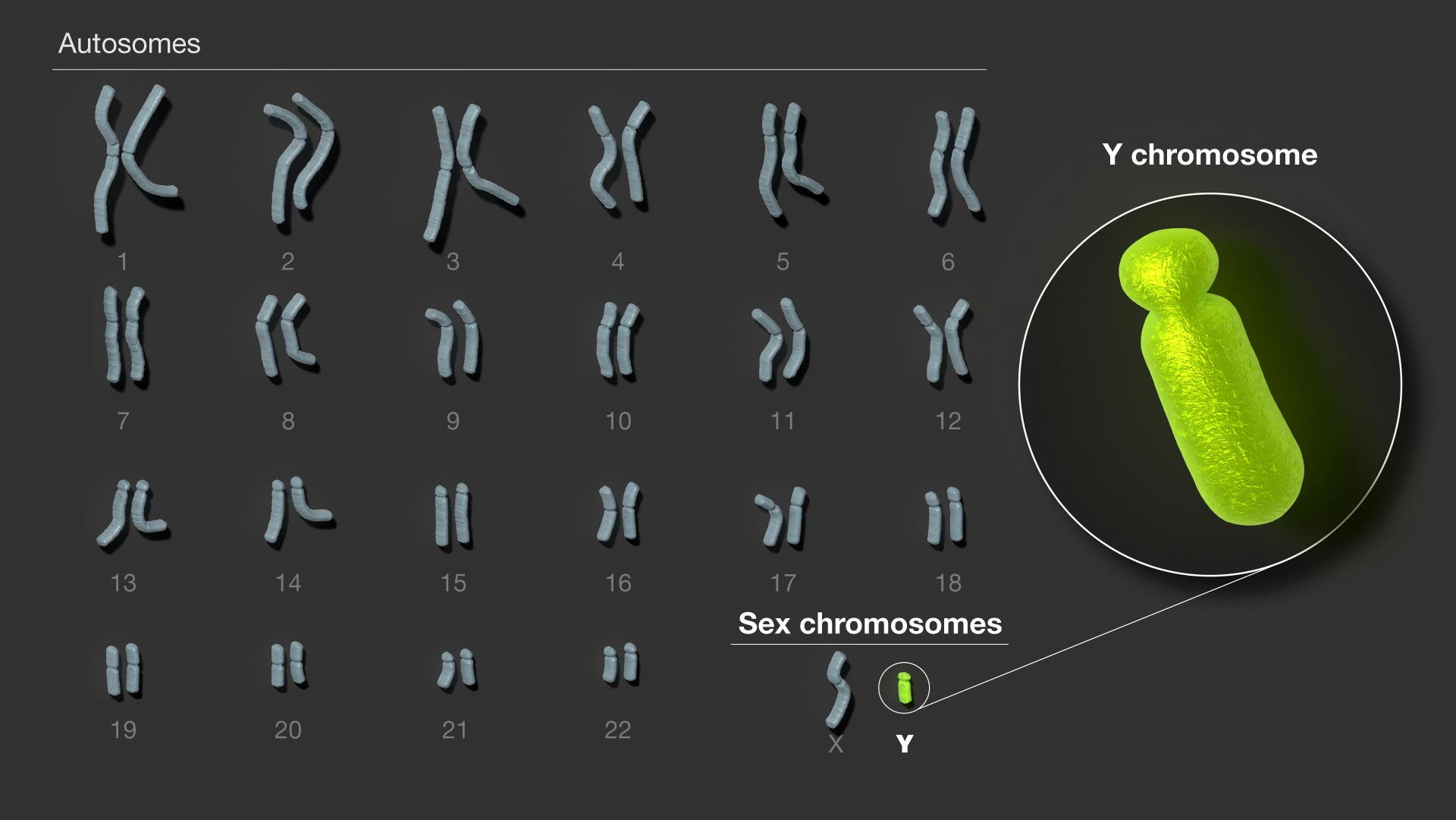
Image Credit: https://scitechdaily.com/images/Human-Y-Chromosome.jpg
4.1. Fertility Insights:
- The fully sequenced Y chromosome uncovers genomic features related to fertility, including factors in sperm production.
- Researchers can now explore male reproductive health with greater precision, potentially addressing infertility issues. [1,2]
- One key region, known as the azoospermia factor (AZF), is critical for sperm production. The complete sequence allows for more precise analysis of deletions in this region, which are linked to male infertility. [3]
4.2. Correcting Misidentifications:
- Consensus Building: By sequencing the same regions multiple times and comparing the sequences, errors can be identified and corrected.
- The new sequence corrects previous misidentifications of bacterial DNA, ensuring accurate reference genomes.
- This accuracy is crucial for understanding genetic disorders and designing targeted therapies. [1]
4.3. Evolutionary Clues:
- By studying Y chromosome variations, we gain insights into human evolution and population changes. [3,4]
- Tracking how the Y chromosome evolved over millennia sheds light on our ancient ancestors’ migrations and interactions. [2]
- The discovery of 41 new genes and 30 million additional base pairs enriches our understanding of human genetic diversity.[2]
5. How It Was Achieved:
5.1. Long-Read Sequencing:
- Technology: Used advanced technologies like PacBio (This generates long reads with high accuracy by repeatedly reading the same DNA segment) and Oxford Nanopore (This technology sequences DNA by threading it through tiny pores, allowing for very long reads).
- Importance: Reads long DNA stretches, essential for decoding repetitive regions of the Y chromosome, which short-read technologies struggle with.[5]
5.2. High-Fidelity Sequencing (HiFi):
- Process: Involves multiple readings of the same DNA segment for high accuracy.
- Impact: Reduces errors, crucial for error-prone regions. [5]
5.3. Integrating Data:
- Platforms: Combined data from PacBio, Oxford Nanopore, and Illumina.
- Why It Works: Cross-checking and validating sequences ensure accuracy and completeness.[5]
5.4. Bioinformatics Algorithms:
- Assembly: Tools like Canu or Flye assembled long reads into contigs.
- Polishing: Tools like Pilon or Racon corrected errors.
- Repetitive Regions: Specialized algorithms ensured accurate representation.[5]
5.5. Validation:
- Optical Mapping: This technique creates a physical map of the Y chromosome to compare with the sequence assembly, ensuring structural accuracy.
- Chromosome Conformation Capture (Hi-C): Provides information about the physical proximity of regions in the chromosome, helping to validate the order and orientation of the sequences.
- Comparative Genomics: Comparing the newly assembled Y chromosome sequence with those from different individuals or species ensures consistency and accuracy.
- Ensuring Accuracy: These methods help confirm that the assembled sequence accurately represents the Y chromosome.[5]
6. Key Genes on the Y Chromosome:
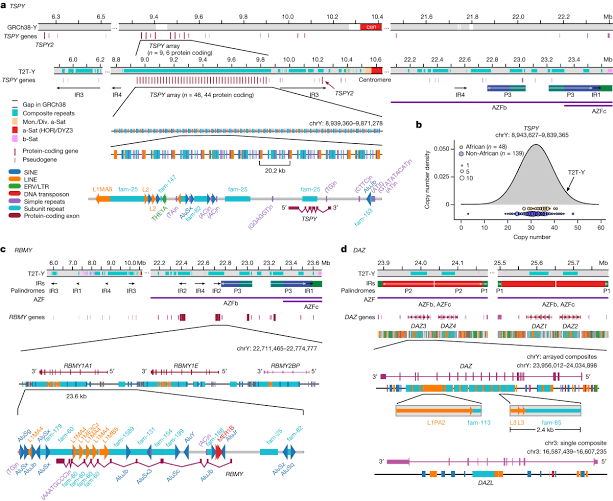
Image Credit:https://www.researchgate.net/profile/Reza-Halabian/publication/373348346/figure/fig2/AS:11431281196452493@1696647289617/Ampliconic-genes-forming-composite-repeats-a-T2T-Y-has-44TSPY-protein-coding-genes_Q320.jpg
Image explained:
(a) T2T-Y has 44 TSPY protein-coding genes, organized in a single continuous array and a single TSPY2 copy, compared with GRCh38-Y which has a gap in the TSPY array. T2T-Y shows a more regularized array and re covers additional TSPY pseudogenes not present in GRCh38-Y.
(b) Copy number differences of TSPY protein-coding copies found in the SGDP.
(c) Repeat composition of the RBMY gene family.
(d) Repeat composition of the DAZ gene family, with one extr a copy annotated on Chr3 that is missing L1PA2. Whereas TSPY and RBMY genes are found within repeat
composites forming arrays, DAZ-associated composites are embedded within the introns of the gene.
6.1. TSPY (Testis-Specific Protein Y-encoded):
- Function: Produces a protein crucial for spermatogenesis (sperm cell development).
- Relevance: Important for germ cell regulation and male fertility.
6.2. RBMY (RNA-Binding Motif Protein Y):
- Function: Encodes RNA-binding proteins vital for sperm development.These proteins are involved in the processing of pre-mRNA (precursor messenger RNA) in spermatogenic cells.
- Relevance: Mutations can lead to male infertility by affecting sperm production.
6.3. DAZ (Deleted in Azoospermia):
- Function: Involved in RNA regulation and essential for germ cell development.
- Relevance: Deletions cause infertility issues like azoospermia (absence of sperm in semen) and oligospermia (low sperm count).
6.4. Study Methodology:
- Sequencing: Long-read and HiFi sequencing ensured accuracy in repetitive regions.
- Bioinformatics: Algorithms assembled and polished sequences.
6.5. Findings:
- Gene Mapping: Precise locations and structures of TSPY, RBMY, and DAZ genes was provided by the complete sequencing of the Y chromosome.
- Medical Relevance: Better diagnostics and targeted treatments for male infertility.
7. Conclusion:
The Y chromosome, once an enigma, now reveals its secrets. As we delve deeper into its mysteries, we unlock knowledge that impacts medicine, genetics, and our understanding of what it means to be human. From the intricacies of male development to the echoes of our evolutionary past, the Y chromosome continues to captivate scientists and storytellers alike.
8. Reference:
Vancouver Style (👈Click here)
- Scitech Daily. Complete Human Y Chromosome Sequence Assembled for the First Time. SciTechDaily. Published July 2, 2024; Available from: https://scitechdaily.com/complete-human-y-chromosome-sequence-assembled-for-the-first-time/. Accessed July 3, 2024.
- SciTechDaily. Y Chromosome Articles. Available from: https://scitechdaily.com/tag/y-chromosome/. Accessed July 3, 2024.
- National Institutes of Health. Researchers Assemble First Complete Sequence of Human Y Chromosome. NIH News Releases. Published July 1, 2024; Available from: https://www.nih.gov/news-events/news-releases/researchers-assemble-first-complete-sequence-human-y-chromosome. Accessed July 3, 2024.
- SciTechDaily. Y Not? The Full Story Behind Sequencing Humanity’s Most Elusive Chromosome. SciTechDaily. Published July 3, 2024; Available from: https://scitechdaily.com/y-not-the-full-story-behind-sequencing-humanitys-most-elusive-chromosome/. Accessed July 3, 2024.
- Rhie A, Nurk S, Cechova M, Hoyt SJ, Taylor DJ, Altemose N, Hook PW, Koren S, Rautiainen M, Alexandrov IA, Allen J, Asri M, Bzikadze AV, Chen NC, Chin CS, Diekhans M, Flicek P, Formenti G, Fungtammasan A, Garcia Giron C, Garrison E, Gershman A, Gerton JL, Grady PGS, Guarracino A, Haggerty L, Halabian R, Hansen NF, Harris R, Hartley GA, Harvey WT, Haukness M, Heinz J, Hourlier T, Hubley RM, Hunt SE, Hwang S, Jain M, Kesharwani RK, Lewis AP, Li H, Logsdon GA, Lucas JK, Makalowski W, Markovic C, Martin FJ, McCartney AM, McCoy RC, McDaniel J, McNulty BM, Medvedev P, Mikheenko A, Munson KM, Murphy TD, Olsen HE, Olson ND, Paulin LF, Porubsky D, Potapova T, Ryabov F, Salzberg SL, Sauria MEG, Sedlazeck FJ, Shafin K, Shepelev VA, Shumate A, Storer JM, Surapaneni L, Taravella Oill AM, Thibaud-Nissen F, Timp W, Tomaszkiewicz M, Vollger MR, Walenz BP, Watwood AC, Weissensteiner MH, Wenger AM, Wilson MA, Zarate S, Zhu Y, Zook JM, Eichler EE, O’Neill RJ, Schatz MC, Miga KH, Makova KD, Phillippy AM. The complete sequence of a human Y chromosome. Nature. 2023 Sep;621(7978):344-354. doi: 10.1038/s41586-023-06457-y. Epub 2023 Aug 23. PMID: 37612512; PMCID: PMC10752217.
Harvard Style (👈Click here)
- SciTech Daily (2024) Complete Human Y Chromosome Sequence Assembled for the First Time. SciTechDaily, 2 July. Available at: https://scitechdaily.com/complete-human-y-chromosome-sequence-assembled-for-the-first-time/ (Accessed: 3 July 2024).
- SciTechDaily (n.d.) Y Chromosome Articles. Available at: https://scitechdaily.com/tag/y-chromosome/ (Accessed: 3 July 2024).
- National Institutes of Health (2024) Researchers Assemble First Complete Sequence of Human Y Chromosome. Available at: https://www.nih.gov/news-events/news-releases/researchers-assemble-first-complete-sequence-human-y-chromosome (Accessed: 3 July 2024).
- SciTechDaily (2024) Y Not? The Full Story Behind Sequencing Humanity’s Most Elusive Chromosome. SciTechDaily. Available at: https://scitechdaily.com/y-not-the-full-story-behind-sequencing-humanitys-most-elusive-chromosome/ (Accessed: 3 July 2024).
- Rhie, A., Nurk, S., Cechova, M., Hoyt, S.J., Taylor, D.J., Altemose, N., Hook, P.W., Koren, S., Rautiainen, M., Alexandrov, I.A., Allen, J., Asri, M., Bzikadze, A.V., Chen, N.C., Chin, C.S., Diekhans, M., Flicek, P., Formenti, G., Fungtammasan, A., Garcia Giron, C., … Phillippy, A.M., 2023. The complete sequence of a human Y chromosome. Nature, 621(7978), pp.344-354. Available at: https://doi.org/10.1038/s41586-023-06457-y [Accessed 3 July 2024].
Latest Posts:


 Lifestyle Science & health