
For decades, the pipeline for new antibiotics ran dry. We were facing a silent pandemic of antimicrobial resistance (AMR), where common infections once easily treated were becoming deadly again. The rise of “superbugs” like MRSA and drug-resistant Gonorrhea loomed large, threatening to send us back to a pre-antibiotic era. But as of early 2026, a new hero has emerged in this fight: Artificial Intelligence.
AI isn’t just speeding up discovery; it’s fundamentally changing how we find and design life-saving drugs. Welcome to the second golden age of antibiotics.
From Haystacks to Blueprints: AI’s New Approach
Historically, finding new antibiotics was like searching for a needle in an immense chemical haystack. Scientists would screen thousands upon thousands of compounds, hoping to stumble upon one that killed bacteria without harming humans. It was slow, expensive, and increasingly fruitless.
”Enter AI” is the moment the narrative shifts from “human struggle” to “machine-augmented triumph.” It marks the transition from the Antibiotic Winter (1980s–2010s) to the Digital Spring.
1. The Shift from Luck to Logic
Before AI, discovery was often accidental (like Fleming finding mold on a petri dish). “Enter AI” means we now use Deep Learning to see patterns in molecular structures that are invisible to the human eye.
- The Halicin Example: In 2019, the AI wasn’t told what an antibiotic looks like; it was told to find molecules that behave like one. It identified Halicin (originally a failed diabetes drug) because it “saw” a unique way the molecule could disrupt the flow of protons across a bacterial membrane.
2. Sifting Through the “Chemical Universe”
There are an estimated 10^{60} potential drug-like molecules—more than there are stars in the galaxy. Humans could only ever test a tiny fraction.
- Enter AI: Machine learning models act as a high-speed “sifter.” In the case of Abaucin (discovered in 2023), AI screened 6,680 compounds in an afternoon and narrowed them down to 240 for physical testing. This would have taken humans years of manual labor.
3. The 2026 Context: Generative vs. Predictive
When you write “Enter AI” today, you are talking about Generative Chemistry.
- Predictive AI (2019): “Does this existing molecule work?”
- Generative AI (2026): “I need a molecule that is shaped like this and sticks to that specific bacterial protein. Build it for me.”
Enter AI. Early breakthroughs saw machine learning models rapidly sifting through existing databases, identifying compounds that humans had overlooked. The antibiotic Halicin, discovered by MIT in 2019, was a prime example. AI predicted it would kill bacteria, and it worked, even against notoriously tough pathogens like C. diff and Tuberculosis.
But today, AI has evolved beyond just screening. We’ve moved into the realm of Generative AI, where the intelligence isn’t just finding existing solutions; it’s creating entirely new ones from scratch.
Designing Drugs “From Atom One”
In late 2025, MIT’s groundbreaking Antibiotics-AI Project announced two game-changing compounds: NG1 and DN1. These weren’t repurposed drugs; they were designed molecule by molecule by AI:
- NG1: This compound was specifically engineered to combat drug-resistant Gonorrhea. It targets a bacterial protein called LptA, crucial for building the outer membrane – a target that human chemists had previously struggled to hit effectively.
- DN1: Built atom by atom, DN1 is designed to fight MRSA (Methicillin-resistant Staphylococcus aureus), a notorious hospital superbug. The AI started with fundamental chemical elements and iteratively constructed a molecule lethal to bacteria but safe for human cells.
This capability to “write” new chemical structures allows us to explore vast areas of the molecular universe that human intuition alone might never consider.
Mining the “Microbial Dark Matter”
Beyond synthetic design, AI is also uncovering ancient secrets. A massive study leveraging machine learning recently scanned the Earth’s “global microbiome”—the collective genetic material of countless microbes found in soil, oceans, and even ancient remains.
The results were astonishing: the AI identified nearly 1 million new antimicrobial molecules hidden within this genomic data. In a truly mind-bending development, researchers even used AI to “de-extinct” molecules from the DNA of Woolly Mammoths and giant sloths, discovering that these ancient proteins could still combat modern-day superbugs. It’s like finding a biological time capsule filled with new weapons.
Unveiling the “How”: Mechanism of Action Solved
One of the greatest challenges in drug discovery has always been understanding the “Mechanism of Action” (MOA)—precisely how a drug kills its target. Without this understanding, clinical development is a long and risky gamble.
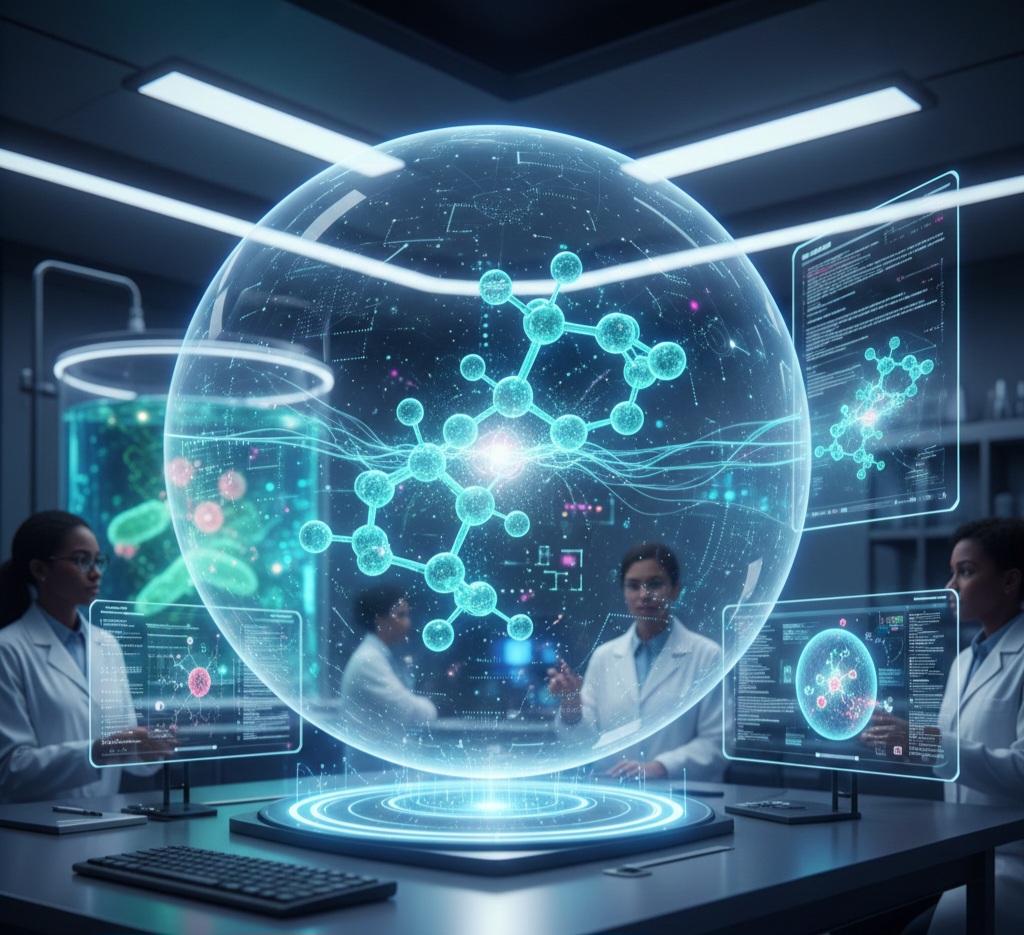
In October 2025, a new AI model called DiffDock, developed by researchers at McMaster and MIT, began to solve this “black box” problem. DiffDock doesn’t just identify potential drugs; it provides a 3D simulation of how the drug molecule “docks” into a bacterial cell, showing exactly which proteins it binds to and how it disrupts essential bacterial functions. This insight is poised to dramatically accelerate the drug development and FDA approval process, potentially saving years of research.
The Future is Now: Key AI-Discovered Antibiotics
The table below highlights some of the most promising AI-discovered antibiotics and their current status:
| Name | Target Pathogen | Status (as of Jan 2026) |
|---|---|---|
| Halicin | E. coli, C. diff, TB | In advanced preclinical trials; demonstrating low human toxicity. |
| Abaucin | A. baumannii (Hospital superbug) | Moving toward Phase 1 clinical trials, showing promise against a particularly tenacious pathogen. |
| NG1 / DN1 | Gonorrhea / MRSA | The most recent generative AI successes (2025); currently undergoing “refinement” by Phare Bio, a leading AI drug discovery company. |
A Glimmer of Hope in the War Against Superbugs
The ability of AI to explore novel chemical spaces, discover hidden molecules in ancient biology, and rapidly elucidate complex mechanisms of action has reignited hope in the fight against antimicrobial resistance. We are no longer limited by human intuition or the slow pace of traditional lab work. With AI as our ally, we are now better equipped than ever to outsmart the evolving threats of superbugs and secure a healthier future.
I have curated a list of the primary research papers and news reports from the leading institutions mentioned MIT, University of Pennsylvania, and Nature Microbiology.
🔗 Primary Research & News Links
1. The Generative AI Breakthrough (NG1 & DN1)
- Official News: MIT News: Using generative AI, researchers design compounds that can kill drug-resistant bacteria (Aug 2025)
- Scientific Context: Fierce Biotech: Generative AI models build new antibiotics starting from a single atom
2. Understanding the “Black Box” (Mechanism of Action)
- Research Paper (Nature Microbiology): Discovery and AI-guided mechanistic elucidation of a narrow-spectrum antibiotic (Oct 2025) (Note: This covers the discovery of Enterololin and the use of DiffDock).
- Technical Summary: MIT News: AI maps how a new antibiotic targets gut bacteria
3. Mining “Microbial Dark Matter”
- Major Study: ScienceDaily: Largest-ever antibiotic discovery effort uses AI to uncover potential cures in microbial dark matter (June 2024/Update 2025)
- Penn Medicine Report: AI designs new antibiotics to take on drug-resistant superbugs
4. The Pioneers: Halicin & Abaucin
- Background: MIT News: Using AI, researchers identify a new class of antibiotic candidates
- Scientific Review: MDPI: Halicin: A New Approach to Antibacterial Therapy
”In a study published in Nature Microbiology, researchers from MIT and McMaster University demonstrated how the AI tool DiffDock can visualize a drug’s ‘docking’ process…”
”According to MIT News, the newly generated compound NG1 targets the LptA protein, a mechanism never before exploited by human-designed drugs.”


- My Choice for the Next Emperor: Anakin Skywalker
- Underrated People in History Who Quietly Built the Modern World
- Great, Fantastic News? First, I Thank God.
- The Second Golden Age: How AI is Resurrecting the Hunt for New Antibiotics
- 💚🌸💜 Green, Pink, and Purple — Colors of Strength, Spirit, and Victory






 Lifestyle Science & health
Thanks never forget God during your highs or lows in life. God bless you🙏