

Steel production is one of the largest contributors to global carbon dioxide emissions, with nearly 2 tonnes of CO2 produced for every tonne of steel. This environmental impact is primarily due to the traditional steel-making process, which involves burning fossil fuels to react carbon with the oxygen in iron ore. However, a new technique that repurposes the hazardous red mud generated from aluminum refining promises to make steel production greener 1
The Problem with Red Mud
Red mud, a byproduct of aluminum production, is stored in huge reservoirs around the world, with an estimated 4 billion tonnes in existence. This red mud poses significant environmental hazards, including the potential for deadly accidents due to its toxic components. It contains between 30 and 60 percent iron oxide by weight, along with dangerous elements like arsenic and lead ¹.
Innovative Solution by the Max Planck Institute
Researchers led by Isnaldi Souza Filho at the Max Planck Institute for Iron Research in Germany have developed a method to extract iron from red mud and use it to produce steel. Their technique involves exposing red mud to a plasma of hydrogen and argon. This process is conducted in a device called an electric arc furnace, heated to a temperature of roughly 1850°C (3362°F). The high temperature, combined with the argon and hydrogen, reacts with the oxygen in the iron oxide, resulting in the formation of iron pellets. These pellets can then be used to produce steel 1 .
Environmental and Industrial Impact
The potential impact of this technique is significant. Co-author Matic Jovičević-Klug from the Max Planck Institute notes that given the amount of red mud available, the process could produce between 748 million and 942 million tonnes of steel. This would result in over a billion tonnes less of CO2 emissions compared to conventional steel-making methods². However, it’s important to note that this scale would still represent only a fraction of the global steel production each year².
Green Hydrogen in Steelmaking
The use of green hydrogen in steelmaking is not entirely new. In 2021, a Swedish consortium called HYBRIT demonstrated a trial run that reduced the carbon footprint of steelmaking by up to 98 percent³. However, the innovative aspect of the Max Planck Institute’s approach is the use of hazardous red mud as a feedstock. According to Mark Jacobson from Stanford University, while the authors of the study claim the process is inexpensive, more information is needed to determine its cost-effectiveness⁴.
Set up :
| Aspect | Details |
|---|---|
| Technology | Hydrogen-based Direct Reduction Iron (H2-DRI) |
| CO2 Emission Reduction | Can cut CO2 emissions by up to 85% in steel mills using this technology |
| Economic Viability | Hydrogen should cost ₹133 (approx. $1.63) per kg for heating and reduction, or ₹141 (approx. $1.70) per kg for just reduction |
| CO2 Reduction with Affordable H2 | Achieves a 76% reduction in CO2 emissions |
| Efficiency Optimization | Reducing excess hydrogen usage can boost efficiency and cost-effectiveness |
| Steel Industry Overview (2023) | – India produced around 106 million metric tonnes of steel (latest data available) – Significant contribution to India’s economy |
| Steel Industry CO2 Impact | Contributes significantly to India’s energy demand and CO2 emissions from the energy sector |
| Feasibility Requirements | Requires affordable clean electricity or CO2 taxes to be economically feasible in India |
| Industry Goals | Aim to reduce carbon emissions through technological upgrades and carbon capture methods |
Decarbonization pathways for iron and steelmaking:
| Aspect | Details |
|---|---|
| Technology | Hydrogen (H2)-based reduction of iron oxide in shaft furnaces |
| Emission Reduction Potential | Can greatly reduce CO2 emissions with renewable electricity; faster reactions in the process |
| Challenges | – Storage of H2 due to fluctuating renewable energy sources – Compressed H2 storage currently expensive – Need for integrating heat due to endothermic reactions |
| Alternative Storage | Using Liquid Organic H2 Carriers (LOHCs), like methanol, which are more cost-effective than compressed H2 storage |
| Techno-Economic Analysis | Comparing H2-based steel production with natural gas (NG)-based methods Includes detailed process models and evaluation of energy use, CO2 emissions, and costs |
| Break-Even Hydrogen Cost (LCOH) | Calculated for making steel with reduced carbon emissions Involves analysis of operational factors and potential process improvements |
| EAF Off-Gas Utilization | Examined for its potential economic benefits in hydrogen-based steelmaking |
| Study Insights | Detailed comparison between NG-based and H2-based steelmaking Highlights economics and operational factors for H2-based methods Provides target costs for feasible operation |
Here’s the Methodology section summarized in a table format suitable for an Indian context:
| Aspect | Details |
|---|---|
| Steel Mill Analysis | Integrated DRI Steel Mill Includes Electric Arc Furnace (EAF), treatment of EAF off-gas, heat/electricity needs, and cooling water systems |
| Inputs | Fuels and Feedstocks – Electricity, Natural Gas (NG), Hydrogen (H2), carbon, lime, iron ore pellets Cost based on procurement prices |
| Emissions | Types – Direct: Emissions within the plant – Indirect: Emissions from the production of inputs |
| Production Capacity | Medium-sized Facility 1,046,000 metric tonnes per year |
| Benchmark | NG-based DRI Facility Used for comparison with the H2-based DRI facility |
| Scenarios Explored | H2 Usage – Replacing NG for heating – Using EAF off-gas to lower energy consumption |
| Reference Processes | NG Usage – Shaft furnace reductant – Reformer fuel – EAF – Ladle refining |
| Analysis Tool | ProSim Plus Software Used to estimate total investment, material/energy efficiency, and permissible cost of hydrogen (LCOH) |
| Economic Viability | Break-Even LCOH A higher break-even LCOH suggests better economic feasibility for H2-based DRI |
This table gives a clear and straightforward overview of the methodology used in the study.
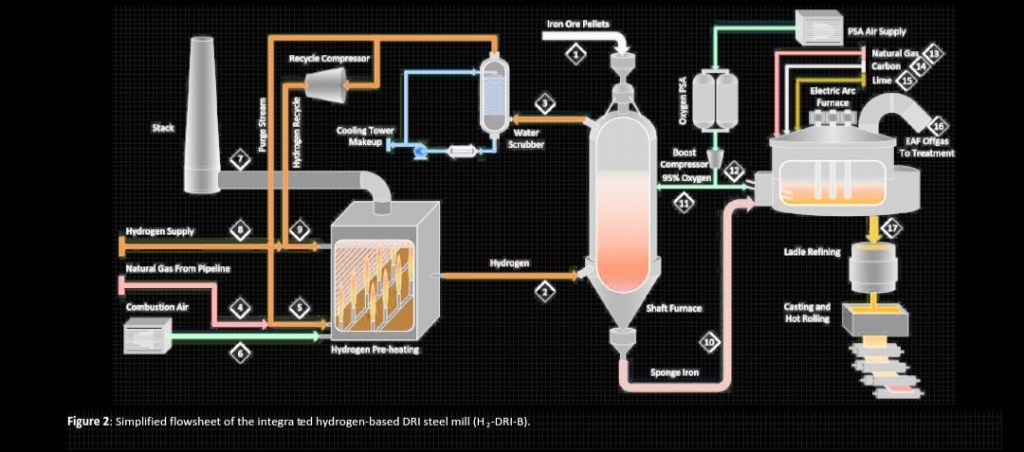
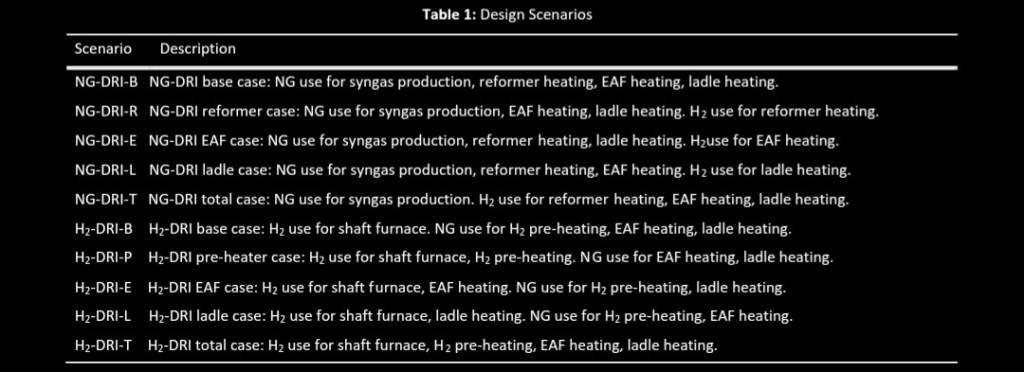
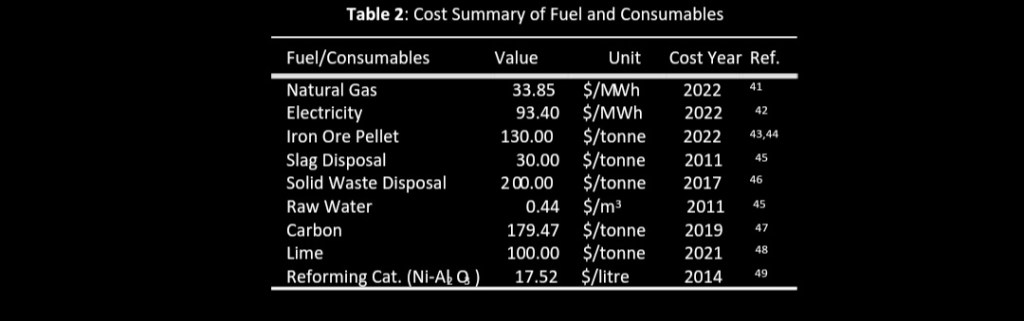
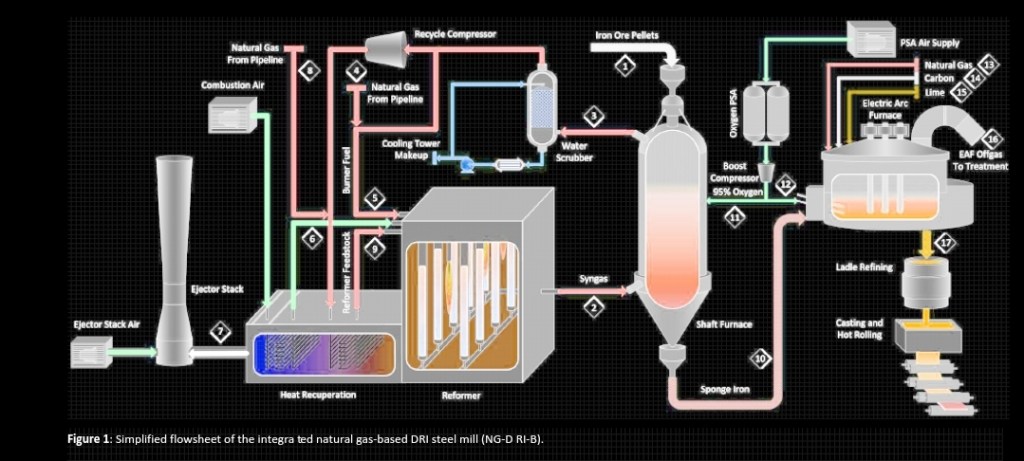
| Aspect | Details |
|---|---|
| Steel Mill Type | Integrated DRI Steel Mill Sponge iron is still hot when loaded into the Electric Arc Furnace (EAF) |
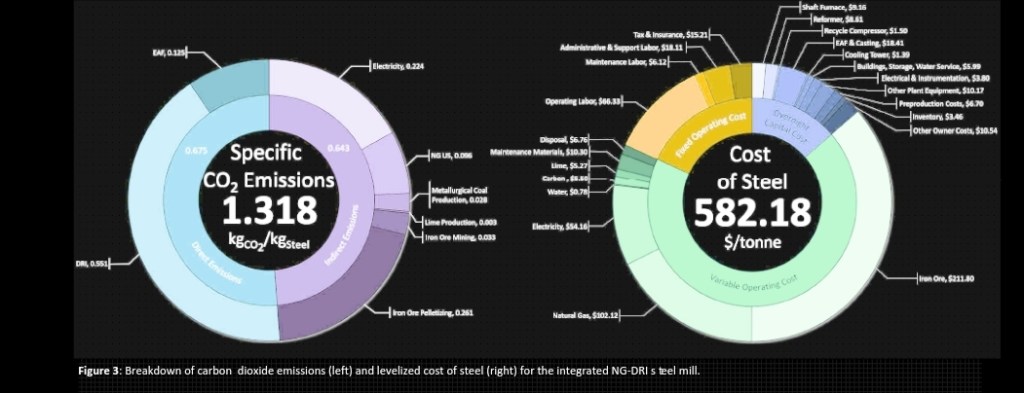
| NG-DRI Flowsheet | Simplified Flowsheet Shows main process units and material streams See Figure 1 and ESI Table S1 for details |
| H2-DRI Flowsheet | Simplified Flowsheet Shows main process units and material streams See Figure 2 and ESI Table S2 for details |
| Natural Gas Reformer | Function Uses reformed NG or syngas as reducing agent for iron oxide Operates at 2.9 bar pressure |
| Reformer Operation | Temperature – Reforming section: 500°C (pre-heating) – Steam reforming: Endothermic reaction with a temperature greater than 1000°C |
| Reformer Feedstock | Composition NG mixed with recycled syngas Pre-heated to 500°C before entering reforming section |
| Reformer Reactions | Equations – Steam Reforming: CH₄ + H₂O → 3H₂ + CO (∆H = +206 kJ/mol) – Water Gas Shift: CO + H₂O → H₂ + CO₂ (∆H = -41 kJ/mol) |
| Catalyst | Type Alumina-supported nickel catalyst |
| Syngas Composition | Outlet Gas 51% H₂, 35% CO, 8% H₂O, 1% CH₄, 5% CO₂ |
| Firebox Operation | Air and Temperature Excess air: 15% Thermodynamic temperature: >1000°C Combustion air pre-heated to 500°C |
| Additional Equipment | Ejector Stack Used due to high flue gas temperature |
This table provides a clear and concise overview of the key points regarding the Direct Reduced Iron (DRI) steel mill and the natural gas reformer used in the process.
Conclusion
The method developed by the Max Planck Institute represents a significant step forward in addressing two major environmental issues: the hazardous waste from aluminum production and the high CO2 emissions from steel production. By turning toxic red mud into a valuable resource for steelmaking, this technique not only offers a greener solution for producing steel but also helps mitigate the environmental risks associated with red mud storage¹. Further research and development could refine this process, potentially making it a viable and cost-effective solution on a global scale.
For further details on this study or project one can go through the reference given below
References
Vancouver Style: ( 👈 Click here )
- Jovičević-Klug M, Souza Filho IR, Springer H, Adam C, Raabe D. Green steel from red mud: Turning industrial waste from aluminum production into climate-neutral metal with hydrogen plasma. Max-Planck-Institut für Eisenforschung; 2024. Available from: https://www.researchgate.net/publication/382365902_Green_steel_from_red_mud_Turning_industrial_waste_from_aluminum_production_into_climate-neutral_metal_with_hydrogen_plasma
- Petersen H, et al. Crystal structures of two titanium phosphate-based proton conductors: ab initio structure solution and materials properties. Inorg Chem. 2022;61(6):2379-2390 (2022). Available from: https://www.researchgate.net/publication/356449026_Crystal_Structures_of_Two_Titanium_Phosphate-Based_Proton_Conductors_Ab_Initio_Structure_Solution_and_Materials_Properties
- Rosner F, Papadias D, Brooks K, Yoro K, Ahluwalia R, Autrey T, Breunig H. Green steel: Design and cost analysis of hydrogen-based direct iron reduction. Green steel: design and cost analysis of hydrogen-based direct iron reduction. Chem.2023. DOI:10.26434/chemrxiv-2023-86j2c Available from: https://www.researchgate.net/publication/369575774_Green_steel_design_and_cost_analysis_of_hydrogen-based_direct_iron_reduction
Follow For Latest Updates :
Feedback will be appreciated on how the blog could be improved:


- My Choice for the Next Emperor: Anakin Skywalker
- Underrated People in History Who Quietly Built the Modern World
- Great, Fantastic News? First, I Thank God.
- The Second Golden Age: How AI is Resurrecting the Hunt for New Antibiotics
- 💚🌸💜 Green, Pink, and Purple — Colors of Strength, Spirit, and Victory


Discover more from Lifestyle Science & health
Subscribe to get the latest posts sent to your email.

 Lifestyle Science & health