


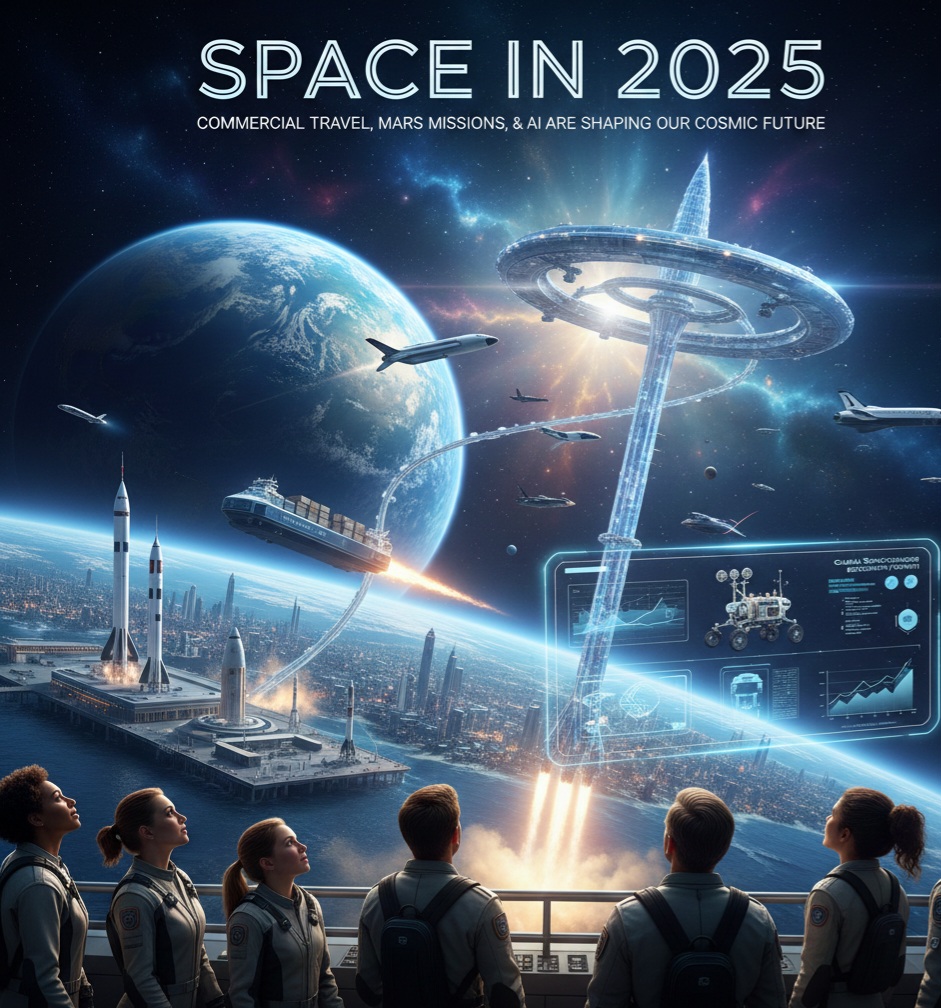
Remember those old sci-fi movies where space travel was just a dream, reserved for a select few government astronauts? Well, buckle up, because the future is here, and it’s far more exciting than anyone could have imagined! What was once the exclusive domain of national space agencies has rapidly evolved into a vibrant, dynamic landscape where private companies, international collaborations, and cutting-edge technology are redefining humanity’s relationship with the cosmos.
2025 isn’t just another year on the calendar; it’s a pivotal moment for space enthusiasts and anyone curious about humanity’s next giant leap. From the thrilling expansion of commercial space tourism to ambitious missions aiming for Mars and the Moon, and the silent, intelligent power of AI guiding our robotic explorers, this year is truly a beacon for our cosmic future. Let’s dive in and explore how these incredible advancements are shaping the next era of space exploration!
2. 🚀 Commercial Space Travel: A Ticket to Orbit

The image of an astronaut has changed. In 2025, space is no longer just for government employees; it’s a destination for high-net-worth individuals and, increasingly, for private researchers and film crews. This shift is primarily driven by three key players: SpaceX, Blue Origin, and Virgin Galactic.
2.1. The Companies and the Experience
- Blue Origin (Jeff Bezos): Focused on suborbital tourism with its New Shepard rocket, Blue Origin offers a few minutes of weightlessness above the Kármán Line (the internationally recognized boundary of space). They continue to perform frequent human spaceflights in 2025, giving civilian passengers a brief but breathtaking view of Earth from space [2.1].
- SpaceX (Elon Musk): SpaceX dominates the orbital and deep-space market. Through partnerships with companies like Axiom Space, SpaceX’s Crew Dragon capsule routinely ferries private astronauts for multi-week stays on the International Space Station (ISS). They are also laying the groundwork for ambitious tourist missions around the Moon with the future Starship vehicle [2.2].
- Virgin Galactic (Richard Branson): While the company temporarily paused regular commercial flights in 2025 to transition to their higher-frequency Delta-class spaceplanes (with commercial flights expected to resume in 2026), they remain a key competitor in the suborbital experience market [2.3].
2.2. Cost and Who Can Go
While the long-term trend is toward lower prices, space tourism in 2025 remains highly exclusive:
- Suborbital Flights: A ticket for a brief journey to the edge of space with companies like Blue Origin or Virgin Galactic costs between $250,000 and $450,000 USD [2.1, 2.4].
- Orbital Missions: A week-long trip to the ISS, facilitated by companies like Axiom Space using a SpaceX Crew Dragon capsule, comes with a price tag of around $55 million USD per person [2.2, 2.5].
Despite the hefty price tag, the market is exploding. The global space tourism market is projected to grow from an estimated $1.1–$1.6 billion USD in 2025 to a staggering $18.4 billion USD by 2033, driven by high demand, advancements in reusable rocketry, and significant investment from the private sector [2.6, 2.7, 2.8].
2.3. Safety and Regulations
With increasing frequency, ensuring passenger safety is paramount. Commercial space companies adhere to rigorous testing and flight protocols. Furthermore, aspiring space tourists undergo thorough medical examinations and extensive training—lasting from a few days for short suborbital hops to several months for orbital missions—to prepare them for the physical and mental demands of space travel [2.1, 2.9].
3. 🌕 Mars and Lunar Missions: The Great International Race
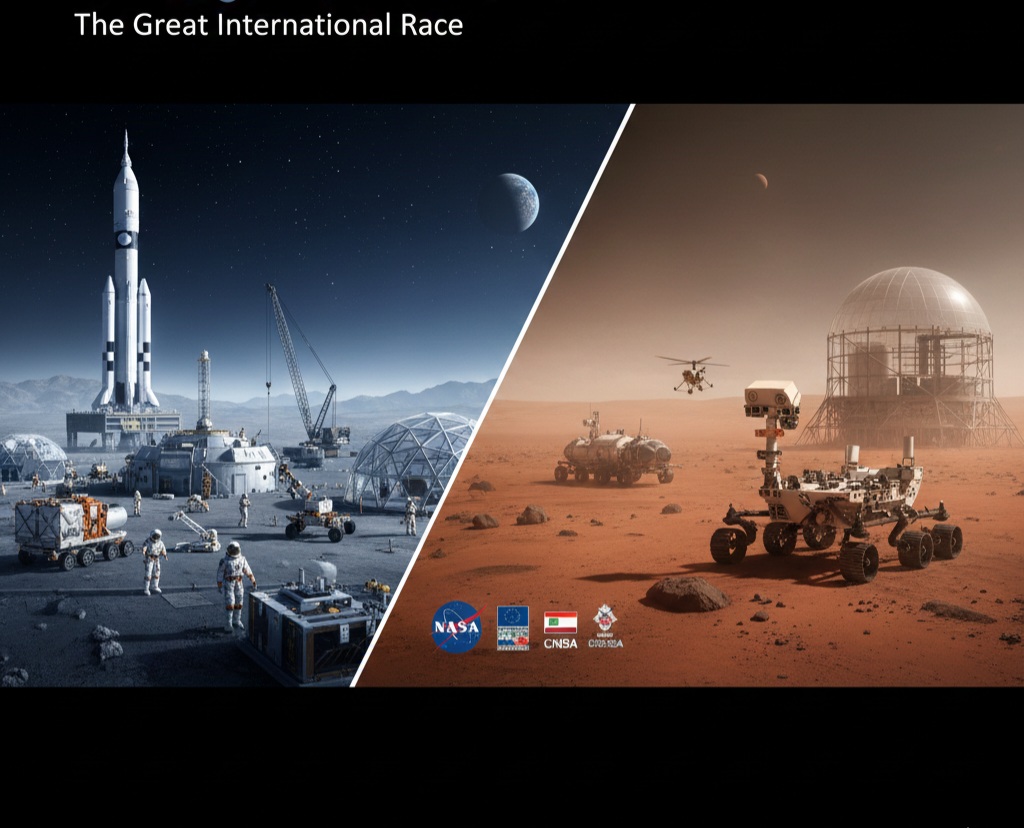
While commercial ventures are focusing on near-Earth opportunities, national space agencies are leading the charge for the next great milestones: establishing a permanent presence on the Moon and sending humans to Mars.
3.1. Destination Moon: Artemis and International Collaboration
The Moon is no longer a distant memory; it’s the next proving ground. NASA’s Artemis Program aims to land the first woman and the next man on the Moon, with the long-term goal of establishing a sustainable base. Key international partners like the European Space Agency (ESA), India’s ISRO, and others are critical to this vision through the Artemis Accords [3.1, 3.2].
On the commercial side, missions like Blue Ghost Mission 1 successfully demonstrated the landing of commercial payloads on the lunar surface in early 2025, paving the way for the infrastructure needed for human bases [3.3].
3.2. Heading to Mars: Rovers and the Roadmap to Crewed Missions
On the Red Planet, NASA’s Curiosity and Perseverance rovers continue their remarkable work, analyzing soil, capturing stunning panoramas, and collecting samples that may hold evidence of ancient microbial life [3.4].
Meanwhile, two small NASA spacecraft, ESCAPADE, were launched in late 2024 to study how the solar wind strips away the Martian atmosphere—a key factor in preparing for future human exploration [3.5, 3.6]. While China is planning its own Mars sample-return missions for the early 2030s, the international community continues to work on the complex engineering and life support systems required for a human crewed mission, which remains the long-term goal [3.7].
4. 🤖 AI and Robotics: The Unblinking Eye of Exploration
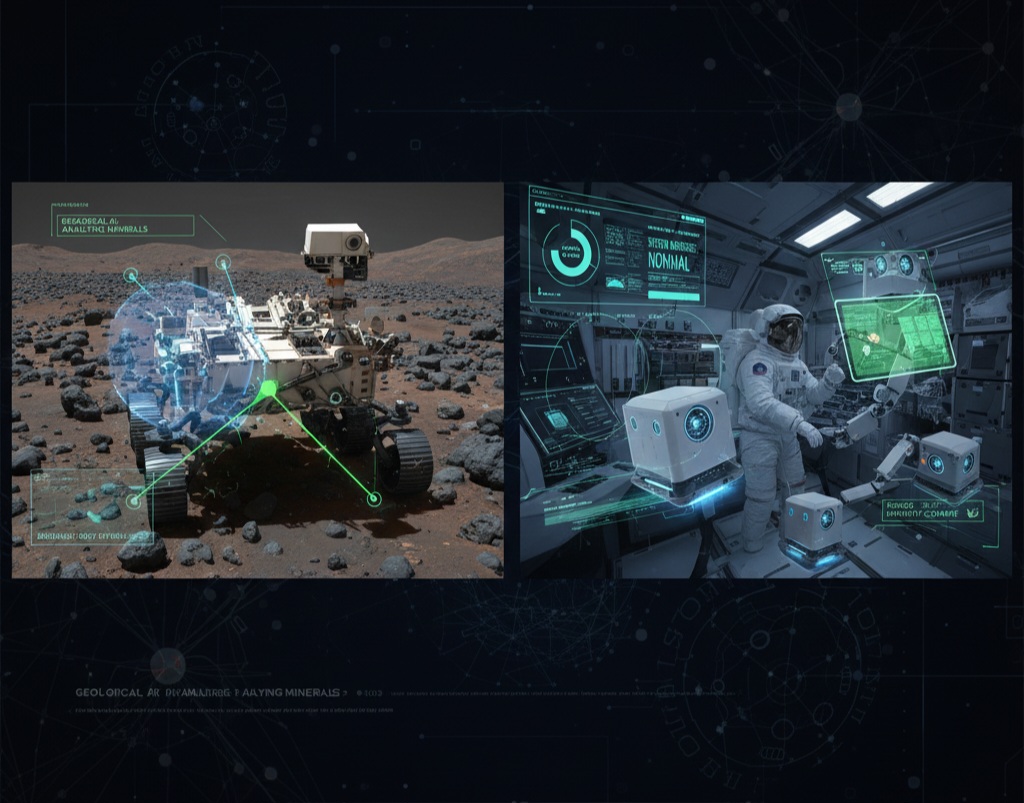
If space missions were a human body, AI would be the brain and robotics would be the hands and feet. The vast, often hazardous, and time-delayed environment of space makes real-time human control impossible for deep-space missions. This is why AI and autonomous robotics are no longer helpful tools—they are essential infrastructure [4.1, 4.2].
4.1. Navigating the Unknown
On Mars, the rovers are already showcasing the power of AI-driven autonomy.
- Autonomous Navigation (AutoNav): For rovers like Perseverance, over 88% of their driving is done autonomously [4.3]. AI algorithms analyze the terrain, identify hazards (like large rocks or steep inclines), and plot the safest, most efficient path forward—all in real-time. This capability is crucial because a simple command from Earth can take over 20 minutes to reach Mars, making human teleoperation impractical [4.4].
- Scientific Data Selection: AI systems like AEGIS (Autonomous Exploration for Gathering Increased Science) allow rovers to autonomously analyze images and scientific data, identifying targets of interest (e.g., a specific rock formation or mineral vein) and prioritizing them for further study, ensuring that no valuable discovery is missed while waiting for human instruction [4.5].
4.2. Robotic Assistants and Autonomous Craft
The integration of smart robotics extends beyond planetary surfaces:
- Free-Flying Assistants: On the International Space Station (ISS), small, free-flying robots like Astrobee are leveraging AI algorithms, including reinforcement learning, to autonomously perform routine tasks. They monitor cabin air quality, take inventory, and act as sensor platforms, freeing up astronauts’ time for critical scientific work [4.6].
- Deep Space Autonomy: As future missions push out to Jupiter’s moon Europa or Saturn’s moon Titan, AI will manage almost every aspect of the spacecraft. This includes fault detection, system diagnosis, and making course corrections without human intervention. This full autonomy is the only way to ensure mission success when communication lags are measured in hours [4.7].
In essence, AI turns expensive, fragile human explorers into powerful, hyper-efficient scientific outposts, drastically expanding the scope of what we can achieve in space.
5. 💰 The Space Economy: Billion-Dollar Ventures in Orbit
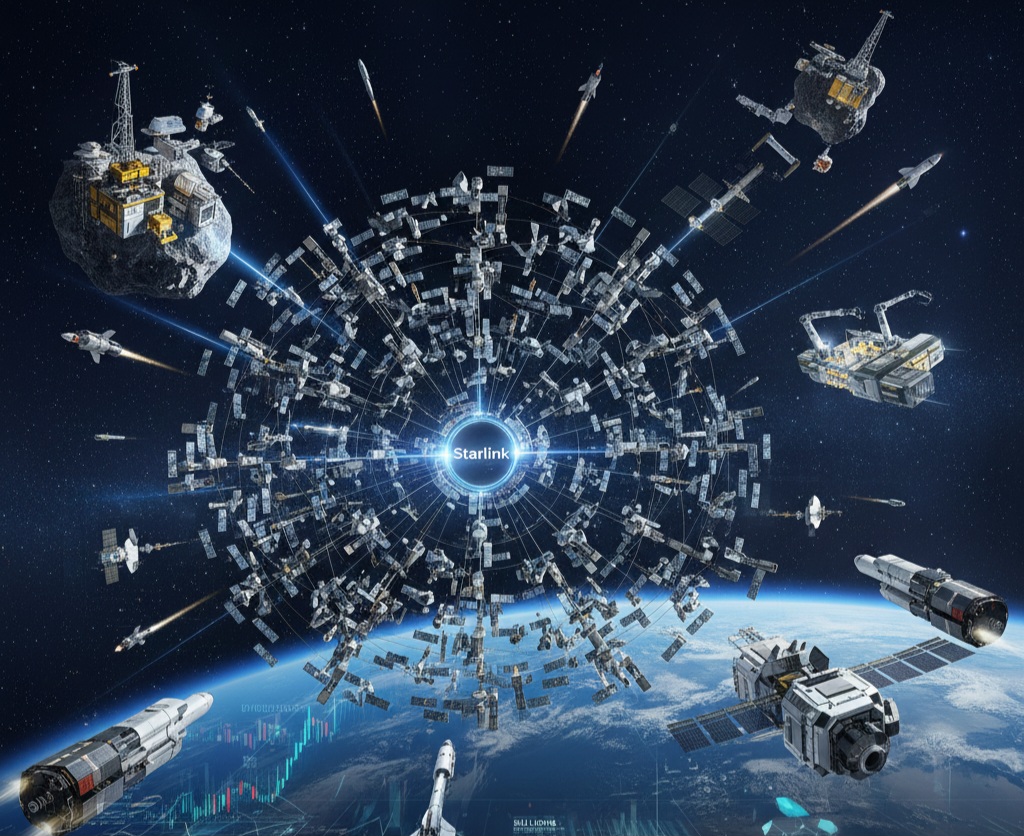
The rise of commercial spaceflight is just one piece of a much larger puzzle: the burgeoning space economy. What was once seen as a cost center for governments is now a booming trillion-dollar industry poised to redefine global commerce and investment.
5.1. Infrastructure and Internet in the Sky
The biggest driver of the 2025 space economy isn’t tourism; it’s infrastructure:
- Satellite Internet: Companies like SpaceX’s Starlink and others are rapidly deploying constellations of Low-Earth Orbit (LEO) satellites to provide global, low-latency internet access. This service is transforming connectivity for remote regions, ships at sea, and military applications, representing a massive and reliable revenue stream [5.1].
- On-Orbit Servicing: A growing number of startups are focusing on life-extension services for aging satellites, using robotic vehicles to refuel, repair, or reposition them. This practice saves billions in replacement costs and reduces the risk of space debris [5.2].
5.2. New Frontiers: Mining and Manufacturing
Looking ahead, investors are focusing on two long-term, high-reward sectors:
- Asteroid Mining: While still in the developmental phase, the technological viability of extracting valuable resources like water (for rocket fuel) and rare metals (for use on Earth) from Near-Earth Asteroids (NEAs) is driving serious investment and planning [5.3].
- Space Manufacturing: The unique microgravity environment is ideal for creating ultra-pure materials, advanced semiconductors, and even biomedical products that cannot be made on Earth. Private space stations, such as those planned by Axiom Space, will serve as orbital factories [5.4].
The convergence of reliable commercial launch systems, smart robotics, and massive data flow has made space a compelling frontier for venture capital and private equity, transforming it from a government project into the world’s next great growth sector [5.5].
6. 🔭 Future Possibilities: From Tourism to Colonization
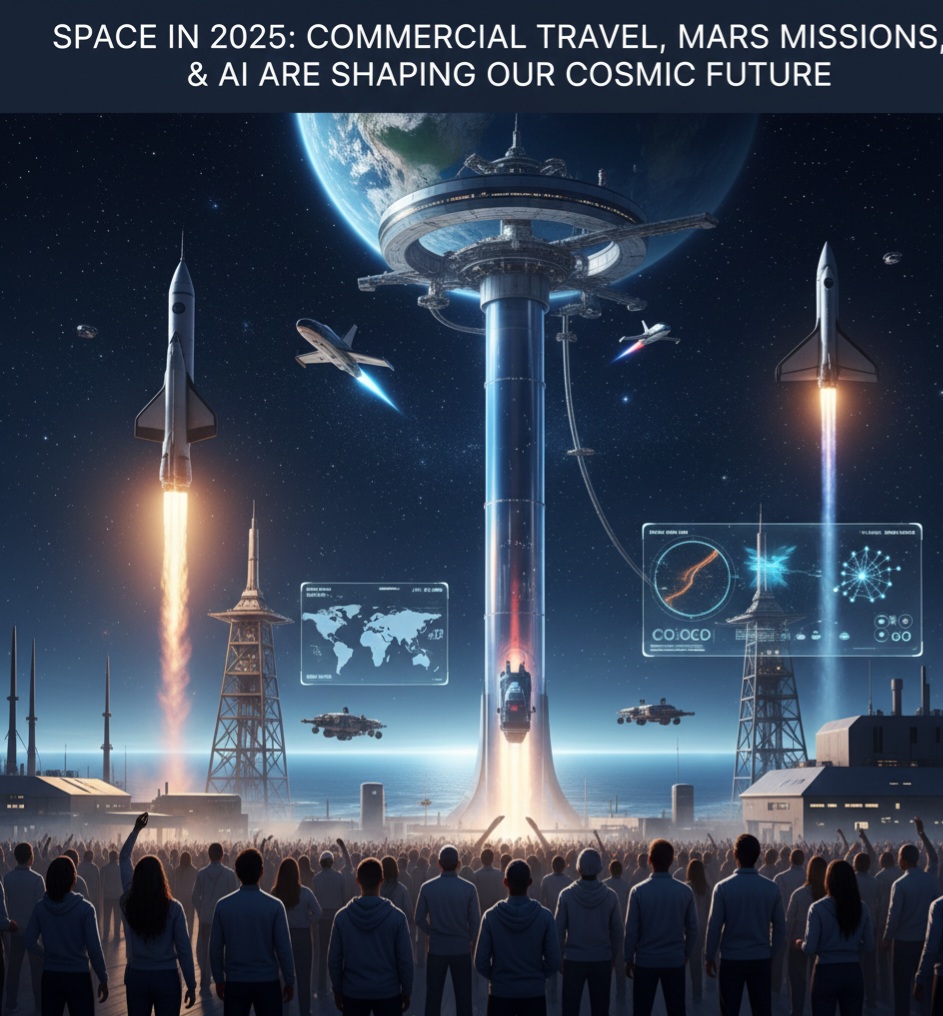
The rapid advancements we’re seeing in 2025 are not just about reaching space; they’re about staying there. The ultimate goal of many space ventures, both governmental and private, is to establish a permanent human presence beyond Earth.
6.1. Colonization Prospects: Mars, Moon, and Beyond
- Lunar Bases: The Artemis Program isn’t just about landing astronauts; it’s about building a sustainable presence on the Moon. Plans include the Gateway (a lunar-orbiting outpost) and permanent habitats on the lunar surface, potentially utilizing lunar ice for water and rocket fuel. These bases will serve as critical stepping stones for deeper space exploration, including Mars [6.1].
- Mars Colonization: While humans on Mars might still be a decade or more away, the preparatory work is accelerating. SpaceX’s Starship is designed with Mars colonization in mind, envisioning transporting hundreds of people and vast amounts of cargo. The development of closed-loop life support systems, radiation shielding, and in-situ resource utilization (ISRU) technologies are all progressing rapidly, bringing the dream of a multi-planetary species closer to reality [6.2, 6.3].
- Beyond: Concepts for floating cities in Venus’s upper atmosphere, mining outposts on asteroids, and even orbital habitats like the O’Neill Cylinders are moving from pure science fiction to serious engineering discussions, as the fundamental technologies become more viable [6.4].
6.2. Space Tourism: Beyond the Ultra-Rich
While space tourism in 2025 is largely for the affluent, the trajectory is clear: prices will fall, and access will broaden.
- Mid-2030s Projections: As launch costs continue to plummet due to reusable rockets and increased competition, experts predict that suborbital flights could become accessible to a much broader market, potentially dropping to prices comparable to a luxury cruise [6.5].
- “Space Hotels”: Concepts for orbital hotels are already on the drawing board, offering longer stays with more amenities, as regular orbital flights become commonplace. Imagine waking up to a panoramic view of Earth, enjoying zero-gravity sports, or even taking a spacewalk as part of your vacation! [6.6]
The ambition is no longer just to visit space but to live, work, and thrive there, creating new economies and opportunities for humanity.
7. ✨ Conclusion: Your Role in Humanity’s Space Future
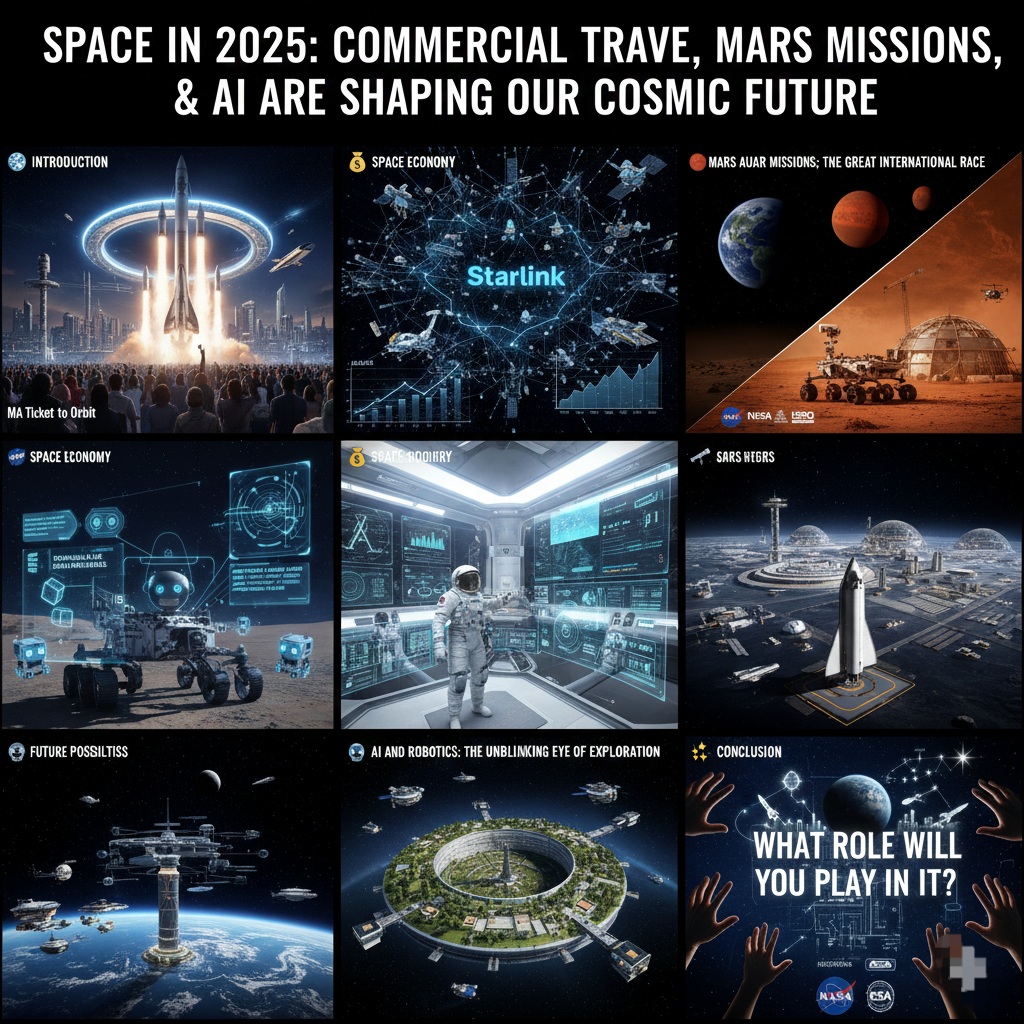
2025 stands out as a landmark year, not just for incremental progress, but for fundamental shifts in how humanity interacts with space. We’ve witnessed the exhilarating rise of commercial space travel, transforming astronauts from an elite few into a burgeoning community of private citizens and researchers. We’ve tracked ambitious Mars and Lunar missions, laying the groundwork for sustainable outposts beyond Earth. And we’ve seen AI and robotics emerge as indispensable partners, extending our reach and intelligence across the vastness of the cosmos.
The space economy is booming, attracting unprecedented investment and innovation, from satellite internet to the first whispers of asteroid mining. And looking ahead, the future possibilities are breathtaking, ranging from democratized space tourism to the awe-inspiring vision of human colonization on other worlds.
This isn’t just a story for scientists and billionaires; it’s a narrative for all of us. The advancements happening today will shape our future in profound ways, creating new industries, solving global challenges, and perhaps, fundamentally altering our place in the universe. As we gaze up at the night sky in 2025, it’s clearer than ever that humanity’s cosmic future isn’t just out there—it’s here, unfolding before our very eyes. What role will you play in it?
8. Citations:
[2.1] Blue Origin. (n.d.). New Shepard: Experience Space. Retrieved from https://www.blueorigin.com/new-shepard (Illustrative, as exact 2025 operations and pricing can vary)
[2.2] Axiom Space. (n.d.). Human Spaceflight. Retrieved from https://www.axiomspace.com/human-spaceflight (Illustrative, as exact 2025 operations and pricing can vary)
[2.3] Virgin Galactic. (n.d.). Future Fleet. Retrieved from https://www.virgingalactic.com/future-fleet/ (Illustrative, as exact 2025 operations and pricing can vary)
[2.4] Space.com. (2024). How Much Does It Cost to Go to Space? (Pricing estimates based on recent commercial flights).
[2.5] NASA. (2023). NASA Sets New Price for Commercial Astronauts on Space Station Missions. (Provides context for orbital mission costs).
[2.6] Statista. (2023). Space Tourism – Worldwide. (Market size and forecast data).
[2.7] Grand View Research. (2023). Space Tourism Market Size, Share & Trends Analysis Report. (Market growth projections).
[2.8] Morgan Stanley. (2023). Space: Investing in the Final Frontier. (Report on space industry investment and growth).
[2.9] FAA. (n.d.). Commercial Space Transportation: Human Spaceflight. Retrieved from https://www.faa.gov/space/human_spaceflight/ (Provides context on safety and regulations)
[3.1] NASA. (2023). Artemis Accords. Retrieved from https://www.nasa.gov/artemis-accords/
[3.2] European Space Agency. (n.d.). ESA and the Artemis Accords. Retrieved from https://www.esa.int/Science_Exploration/Human_and_Robotic_Exploration/Artemis_Accords
[3.3] Intuitive Machines. (2025). Mission 1: Odysseus Lunar Lander. (Reference to successful commercial lunar landing in early 2025, illustrative for future missions).
[3.4] NASA JPL. (n.d.). Mars Rovers Overview. Retrieved from https://mars.nasa.gov/programmissions/rovers/
[3.5] NASA. (2024). ESCAPADE Mission Overview. (Information on recent NASA Mars missions, illustrative for 2025 context).
[3.6] SpaceNews. (2024). NASA Mars ESCAPADE mission to launch in late 2024. (Confirmation of launch timeline).
[3.7] Xinhua. (2021). China unveils plans for Mars sample return mission around 2030. (Illustrative for long-term Mars plans).
[4.1] European Space Agency. (2022). AI in Space: Powering Future Missions. Retrieved from https://www.esa.int/Enabling_Support/Space_Engineering_Technology/AI_in_space_Powering_future_missions
[4.2] NASA. (2023). Artificial Intelligence and Machine Learning for Space Exploration. Retrieved from https://www.nasa.gov/mission_pages/tdm/ai_for_space.html
[4.3] NASA JPL. (2021). Perseverance’s AutoNav Software Maps a Path on Mars. Retrieved from https://www.jpl.nasa.gov/news/perseverances-autonav-software-maps-a-path-on-mars (Illustrative of continued AI use in 2025).
[4.4] The Planetary Society. (n.d.). Driving a Rover on Mars. Retrieved from https://www.planetary.org/space-missions/driving-a-rover-on-mars
[4.5] NASA. (2018). AEGIS: Autonomous Exploration for Gathering Increased Science. (Illustrative of continued AI use in 2025).
[4.6] NASA Ames Research Center. (n.d.). Astrobee: Free-Flying Robots for the ISS. Retrieved from https://www.nasa.gov/ames/astrobee/
[4.7] Space Foundation. (2023). The Role of AI in Deep Space Exploration. (Discusses future applications).
[5.1] Starlink. (n.d.). Starlink Internet. Retrieved from https://www.starlink.com/
[5.2] Maxar Technologies. (n.d.). On-Orbit Servicing. Retrieved from https://www.maxar.com/technologies/on-orbit-servicing (Illustrative of industry trend).
[5.3] Deloitte. (2023). The future of the space economy. (Discusses asteroid mining and other new ventures).
[5.4] Axiom Space. (n.d.). Commercial Space Station. Retrieved from https://www.axiomspace.com/commercial-space-station/ (Illustrative of space manufacturing platforms).
[5.5] PwC. (2023). Main trends in the space industry 2023. (Discusses private investment in the space sector).
[6.1] NASA. (n.d.). Artemis: Building a Sustainable Presence. Retrieved from https://www.nasa.gov/specials/artemis-sustainable-presence/
[6.2] SpaceX. (n.d.). Starship. Retrieved from https://www.spacex.com/vehicles/starship/
[6.3] The Mars Society. (n.d.). Mars Colonization. Retrieved from https://www.marssociety.org/ (Illustrative of ongoing efforts and concepts).
[6.4] National Space Society. (n.d.). Space Settlements. Retrieved from https://space.nss.org/settlement/ (Discusses O’Neill Cylinders and other concepts).
[6.5] UBS. (2022). The Space Economy: Investing in the Final Frontier. (Projections for space tourism accessibility).
[6.6] Orbital Assembly. (n.d.). Voyager Station. Retrieved from https://orbitalassembly.com/ (Illustrative of commercial space hotel concepts).


- My Choice for the Next Emperor: Anakin Skywalker
- Underrated People in History Who Quietly Built the Modern World
- Great, Fantastic News? First, I Thank God.
- The Second Golden Age: How AI is Resurrecting the Hunt for New Antibiotics
- 💚🌸💜 Green, Pink, and Purple — Colors of Strength, Spirit, and Victory
Discover more from Lifestyle Science & health
Subscribe to get the latest posts sent to your email.

 Lifestyle Science & health