
Posted in Science & Tech , Education

Turning Toxic Mud from Aluminum Production into Greener Steel.

Steel production is one of the largest contributors to global carbon dioxide emissions, with nearly 2 tonnes of CO2 produced for every tonne of steel. This environmental impact is primarily due to the traditional steel-making process, which involves burning fossil fuels to react carbon with the oxygen in iron ore. However, a new technique that repurposes the hazardous red mud generated from aluminum refining promises to make steel production greener 1

Source: YouTube ( Published on 12th July 2024 )

The Problem with Red Mud

Red mud, a byproduct of aluminum production, is stored in huge reservoirs around the world, with an estimated 4 billion tonnes in existence. This red mud poses significant environmental hazards, including the potential for deadly accidents due to its toxic components. It contains between 30 and 60 percent iron oxide by weight, along with dangerous elements like arsenic and lead ยน.

Innovative Solution by the Max Planck Institute

Researchers led by Isnaldi Souza Filho at the Max Planck Institute for Iron Research in Germany have developed a method to extract iron from red mud and use it to produce steel. Their technique involves exposing red mud to a plasma of hydrogen and argon. This process is conducted in a device called an electric arc furnace, heated to a temperature of roughly 1850ยฐC (3362ยฐF). The high temperature, combined with the argon and hydrogen, reacts with the oxygen in the iron oxide, resulting in the formation of iron pellets. These pellets can then be used to produce steel 1 .

Environmental and Industrial Impact

The potential impact of this technique is significant. Co-author Matic Joviฤeviฤ‡-Klug from the Max Planck Institute notes that given the amount of red mud available, the process could produce between 748 million and 942 million tonnes of steel. This would result in over a billion tonnes less of CO2 emissions compared to conventional steel-making methodsยฒ. However, it’s important to note that this scale would still represent only a fraction of the global steel production each yearยฒ.

Green Hydrogen in Steelmaking

The use of green hydrogen in steelmaking is not entirely new. In 2021, a Swedish consortium called HYBRIT demonstrated a trial run that reduced the carbon footprint of steelmaking by up to 98 percentยณ. However, the innovative aspect of the Max Planck Instituteโ€™s approach is the use of hazardous red mud as a feedstock. According to Mark Jacobson from Stanford University, while the authors of the study claim the process is inexpensive, more information is needed to determine its cost-effectivenessโด.

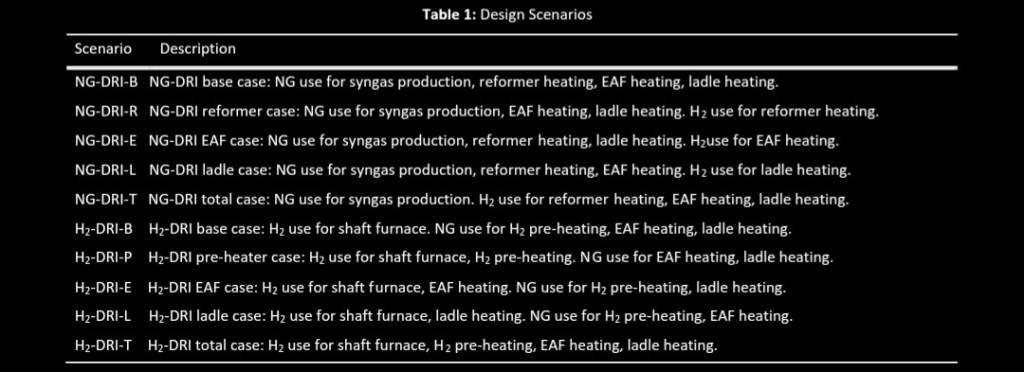
Set up :

Source: Research Gate ( Published on March 2023 )
AspectDetails
TechnologyHydrogen-based Direct Reduction Iron (H2-DRI)
CO2 Emission ReductionCan cut CO2 emissions by up to 85% in steel mills using this technology
Economic ViabilityHydrogen should cost โ‚น133 (approx. $1.63) per kg for heating and reduction, or โ‚น141 (approx. $1.70) per kg for just reduction
CO2 Reduction with Affordable H2Achieves a 76% reduction in CO2 emissions
Efficiency OptimizationReducing excess hydrogen usage can boost efficiency and cost-effectiveness
Steel Industry Overview (2023)– India produced around 106 million metric tonnes of steel (latest data available)
– Significant contribution to India’s economy
Steel Industry CO2 ImpactContributes significantly to India’s energy demand and CO2 emissions from the energy sector
Feasibility RequirementsRequires affordable clean electricity or CO2 taxes to be economically feasible in India
Industry GoalsAim to reduce carbon emissions through technological upgrades and carbon capture methods

Decarbonization pathways for iron and steelmaking:

AspectDetails
TechnologyHydrogen (H2)-based reduction of iron oxide in shaft furnaces
Emission Reduction PotentialCan greatly reduce CO2 emissions with renewable electricity; faster reactions in the process
Challenges– Storage of H2 due to fluctuating renewable energy sources
– Compressed H2 storage currently expensive
– Need for integrating heat due to endothermic reactions
Alternative StorageUsing Liquid Organic H2 Carriers (LOHCs), like methanol, which are more cost-effective than compressed H2 storage
Techno-Economic AnalysisComparing H2-based steel production with natural gas (NG)-based methods
Includes detailed process models and evaluation of energy use, CO2 emissions, and costs
Break-Even Hydrogen Cost (LCOH)Calculated for making steel with reduced carbon emissions
Involves analysis of operational factors and potential process improvements
EAF Off-Gas UtilizationExamined for its potential economic benefits in hydrogen-based steelmaking
Study InsightsDetailed comparison between NG-based and H2-based steelmaking
Highlights economics and operational factors for H2-based methods
Provides target costs for feasible operation

Hereโ€™s the Methodology section summarized in a table format suitable for an Indian context:

AspectDetails
Steel Mill AnalysisIntegrated DRI Steel Mill
Includes Electric Arc Furnace (EAF), treatment of EAF off-gas, heat/electricity needs, and cooling water systems
InputsFuels and Feedstocks
– Electricity, Natural Gas (NG), Hydrogen (H2), carbon, lime, iron ore pellets
Cost based on procurement prices
EmissionsTypes
– Direct: Emissions within the plant
– Indirect: Emissions from the production of inputs
Production CapacityMedium-sized Facility
1,046,000 metric tonnes per year
BenchmarkNG-based DRI Facility
Used for comparison with the H2-based DRI facility
Scenarios ExploredH2 Usage
– Replacing NG for heating
– Using EAF off-gas to lower energy consumption
Reference ProcessesNG Usage
– Shaft furnace reductant
– Reformer fuel
– EAF
– Ladle refining
Analysis ToolProSim Plus Software
Used to estimate total investment, material/energy efficiency, and permissible cost of hydrogen (LCOH)
Economic ViabilityBreak-Even LCOH
A higher break-even LCOH suggests better economic feasibility for H2-based DRI

This table gives a clear and straightforward overview of the methodology used in the study.
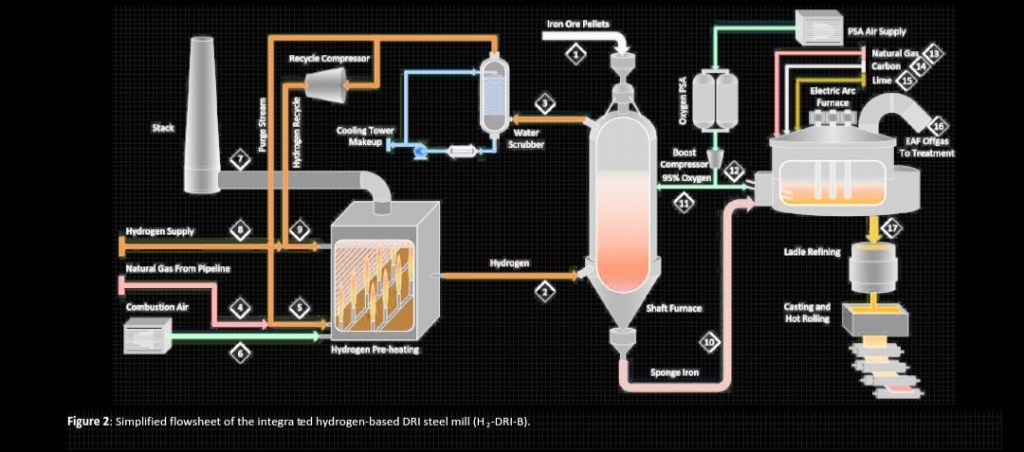
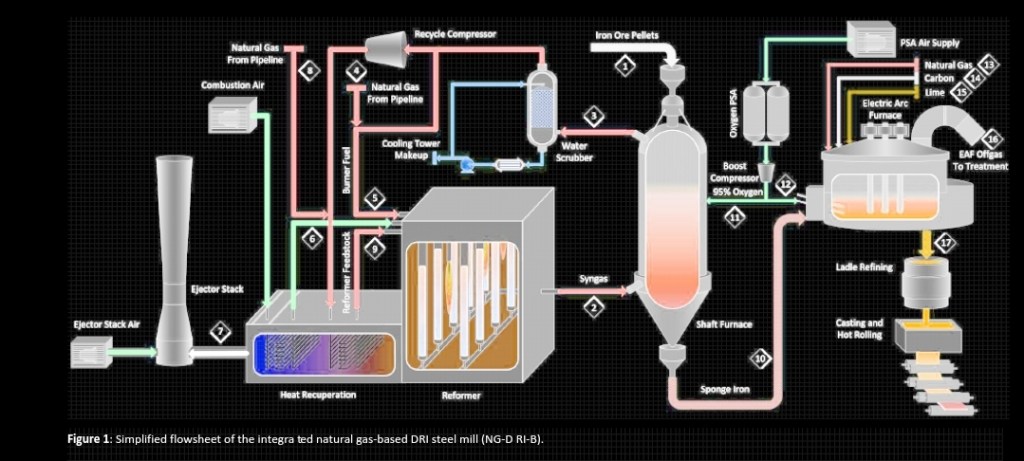
Source: Research Gate ( Published on March 2023 )
AspectDetails
Steel Mill TypeIntegrated DRI Steel Mill
Sponge iron is still hot when loaded into the Electric Arc Furnace (EAF)
NG-DRI FlowsheetSimplified Flowsheet
Shows main process units and material streams
See Figure 1 and ESI Table S1 for details
H2-DRI FlowsheetSimplified Flowsheet
Shows main process units and material streams
See Figure 2 and ESI Table S2 for details
Natural Gas ReformerFunction
Uses reformed NG or syngas as reducing agent for iron oxide
Operates at 2.9 bar pressure
Reformer OperationTemperature
– Reforming section: 500ยฐC (pre-heating)
– Steam reforming: Endothermic reaction with a temperature greater than 1000ยฐC
Reformer FeedstockComposition
NG mixed with recycled syngas
Pre-heated to 500ยฐC before entering reforming section
Reformer ReactionsEquations
– Steam Reforming: CHโ‚„ + Hโ‚‚O โ†’ 3Hโ‚‚ + CO (โˆ†H = +206 kJ/mol)
– Water Gas Shift: CO + Hโ‚‚O โ†’ Hโ‚‚ + COโ‚‚ (โˆ†H = -41 kJ/mol)
CatalystType
Alumina-supported nickel catalyst
Syngas CompositionOutlet Gas
51% Hโ‚‚, 35% CO, 8% Hโ‚‚O, 1% CHโ‚„, 5% COโ‚‚
Firebox OperationAir and Temperature
Excess air: 15%
Thermodynamic temperature: >1000ยฐC
Combustion air pre-heated to 500ยฐC
Additional EquipmentEjector Stack
Used due to high flue gas temperature

This table provides a clear and concise overview of the key points regarding the Direct Reduced Iron (DRI) steel mill and the natural gas reformer used in the process.
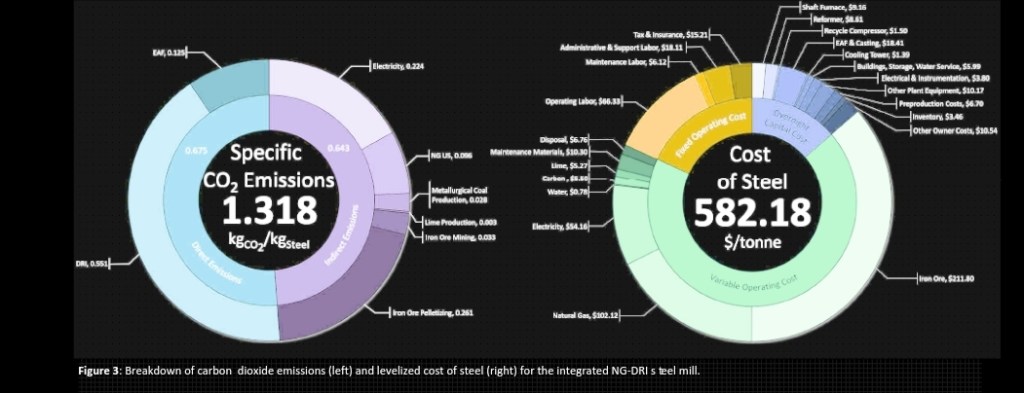
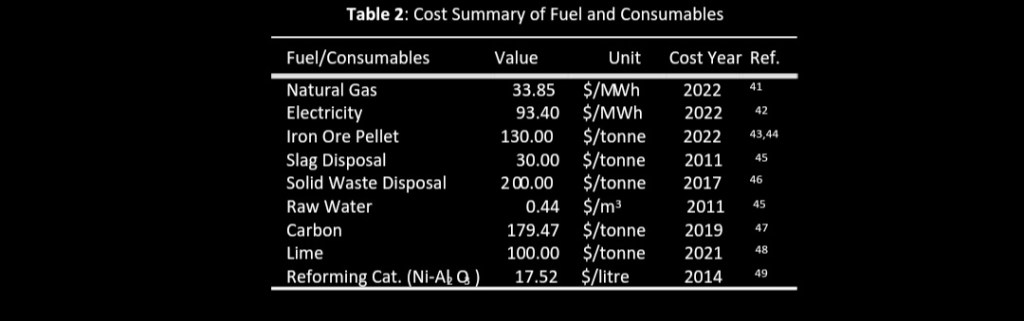
Breakdown of cost of Co2 Emmision & Cost of Steel in study conducted. Source: Research Gate ( Published on March 2023 )

Conclusion

The method developed by the Max Planck Institute represents a significant step forward in addressing two major environmental issues: the hazardous waste from aluminum production and the high CO2 emissions from steel production. By turning toxic red mud into a valuable resource for steelmaking, this technique not only offers a greener solution for producing steel but also helps mitigate the environmental risks associated with red mud storageยน. Further research and development could refine this process, potentially making it a viable and cost-effective solution on a global scale.

For further details on this study or project one can go through the reference given below

References

Vancouver Style: ( ๐Ÿ‘ˆ Click here )
  1. Joviฤeviฤ‡-Klug M, Souza Filho IR, Springer H, Adam C, Raabe D. Green steel from red mud: Turning industrial waste from aluminum production into climate-neutral metal with hydrogen plasma. Max-Planck-Institut fรผr Eisenforschung; 2024. Available from: https://www.researchgate.net/publication/382365902_Green_steel_from_red_mud_Turning_industrial_waste_from_aluminum_production_into_climate-neutral_metal_with_hydrogen_plasma
  2. Petersen H, et al. Crystal structures of two titanium phosphate-based proton conductors: ab initio structure solution and materials properties. Inorg Chem. 2022;61(6):2379-2390 (2022). Available from: https://www.researchgate.net/publication/356449026_Crystal_Structures_of_Two_Titanium_Phosphate-Based_Proton_Conductors_Ab_Initio_Structure_Solution_and_Materials_Properties
  3. Rosner F, Papadias D, Brooks K, Yoro K, Ahluwalia R, Autrey T, Breunig H. Green steel: Design and cost analysis of hydrogen-based direct iron reduction. Green steel: design and cost analysis of hydrogen-based direct iron reduction. Chem.2023. DOI:10.26434/chemrxiv-2023-86j2c Available from: https://www.researchgate.net/publication/369575774_Green_steel_design_and_cost_analysis_of_hydrogen-based_direct_iron_reduction

Follow For Latest Updates :

Feedback will be appreciated on how the blog could be improved:

โ† Back

Thank you for your response. โœจ

Please rate the blog with the chocolates below:(required)

Sep 2026
M T W T F S S
 123456
78910111213
14151617181920
21222324252627
282930  
Daily writing prompt
How would you describe yourself to someone?
Posted in Daily Prompt

I never plans….It’s with God

What are your future travel plans?

Source: AI-generated image created using Microsoft Copilot

I am a person who think we ourselves are gods creation that’s gods plan. So planning today might not be what result you get tomorrow just see today’s……

Whatever I have seen sudden decisions are what mostly happens than planned ones….๐Ÿ˜…. As in my case whenever we friends plans to go outside it gets extended only it never happen but when sudden decisions taken it do….so I never plans ….i don’t know how many of them have faced this same issues….but this is what i have seen๐Ÿ˜…

I leave it in gods decision….because I don’t have any knowledge about this world or future world because am in today…..so let’s see where God guides me to right path….

Also currently I don’t prefer to travel too distance alone ๐Ÿ˜…๐Ÿคฃ. I would  like my family with me๐Ÿ˜. I hope you too as well….I know there may be solo travellers also that’s one’s choice… freedom of choice right if I am not wrong….

Praise the Lord ๐Ÿ™

Regards,

Rittu Sara Raju.

Have a Nice Day๐Ÿ˜ƒ

Daily writing prompt
What are your future travel plans?
Posted in Daily Prompt

All kind of dishes as long as it is not too much harmful ๐Ÿ˜…

Whatโ€™s your go-to comfort food?

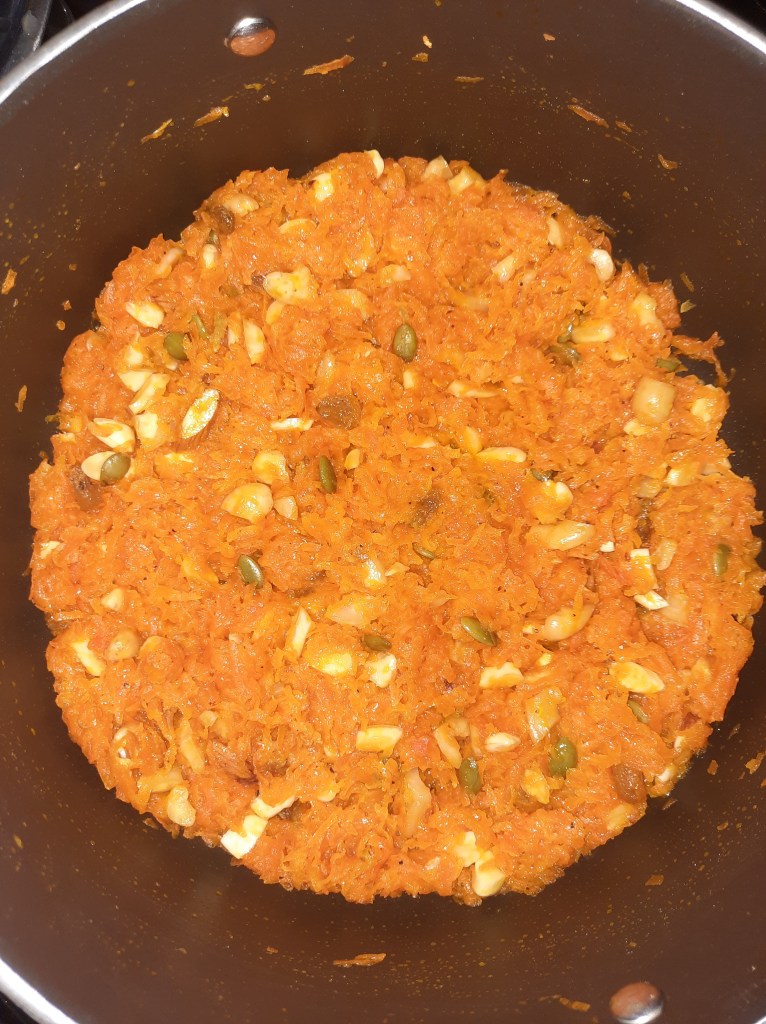
If to say what my kind of go-to comfort food I like south Indian food sadya if you go to kerala you must give a try , then south Indian payasam ( a kind of sweet made of milk, clarified butter, sugar, vermicelli and nuts ) , north Indian sweets like carrot halwa ( made from carrot, milk, sugar, cardamom, clarified butter & nuts ) which i usually make. Today i made one i will share the pic here๐Ÿ˜…, then momidians chicken rice ( biryani) even i make at home whenever free. Also do my mom, even my dad make good chicken curry , Pani puri,  then Punjabi food bature and curries , then rotis, Eggs, I do like dishes made from fishes, prawns, crabs, oysters, fish eggs then tapioca, Jackfruit seeds, then nuts, all kind of fruits, and list goes soo..on…

I even do like English foods as well i like pastas ( macroni), asian food like noodles and other dishes as well….Everytime we go somewhere we see new things we try new foods and some do even post them in social media if I am not wrong. I guess most of them do. Even I do sometimes but very often. I hope everyone has their favorite one, these are mine some lists๐Ÿ˜…

Hope you like this blog . If any suggestions let me know in the comments below.๐Ÿ˜€

Regards,

Rittu Sara Raju.๐Ÿ˜€

“Delicious meals are the secret ingredients to joyful memories.” โค๏ธ๐Ÿฌ๐Ÿค๐Ÿฒ๐Ÿฅ˜๐Ÿš

Daily writing prompt
Whatโ€™s your go-to comfort food?
Posted in Daily Prompt

I guess one should seek both….

Are you seeking security or adventure?


In my view, we should seek both security and adventure in life. There are times when we need our families and friends around us, offering support and comfort. At the same time, adventure is what teaches us new things and allows us to explore. Often, without even realizing it, our lives are full of adventureโ€”we are the explorers of our own journeys.

Every time we encounter something new and strive to learn or find a solution, that itself is an adventure. Whether it’s traveling to a new place and navigating unfamiliar routes, learning a new subject, or venturing into a new field or business, these experiences are all adventures in our lives. Adventures are a fundamental part of life, while the security provided by our families and friends is essential and comforting, and they should not there just for times of need but part of our life๐Ÿ˜….

Relationships shouldn’t be like things you use once and throw away. Instead, they should be like adhesive bonds that stick around. Think about how when you stick something in your DIY crafts, it stays put! (Never mind that sometimes we end up tossing those DIY creations. ๐Ÿ˜… Even I do it sometimes, but we cherish the good memories, right?)

Imagine a relationship like paper and glue: one is the paper, the other the glue. Or like paper and a pen: one is the paper, the other the pen. Without the pen, how will we write on the paper? Without the glue, how will we make crafts? And let’s not even get started on folding paper crafts! ๐Ÿ˜‚ I know some of you thought of that!

So, what I’m saying is, strong relationships are like strong glue or a reliable pen. It might sound funny, but everyone has their own perspective. ๐Ÿ˜…๐Ÿ˜ Hope you found this interesting! If you have any suggestions, let me know in the comments below. ๐Ÿ˜€


Regards,

Rittu Sara Raju

“True adventure lies in embracing the unknown ๐ŸŒŒ, while security often hides behind the illusion of certainty ๐Ÿ›ก๏ธ.”

Daily writing prompt
Are you seeking security or adventure?
Posted in Daily Prompt

All most all genere of music depends on situation and timing๐Ÿ˜…๐Ÿคฃ๐Ÿ˜…

What is your favorite genre of music?

According to my taste I love every genere of music….if we keep our mind calm & surrounding noiseless we can actually hear those beautiful chirping of the birds those sparrows, Robins & many kind of birds , the whistling sound of the breeze & wind waves , the dazling sound of those rain or the raindrops falling to the soil from your window pane . We can hardly see this in city side but those who are in country side or like who goes for vacation towards countryside might be knowing it or experienced it…..

Other is the Christian orthodox worship songs, hillsongs….and devotional songs….

Yes I do like some….80s, 90s to 2000s hit songs that nostalgic kind of songs which give soothness to mind….those songs had real meaning and those songs were written by real poets and dedicated artist which rarely you can get in this generation songs….

I guess we all listen to old hit songs….all the time when we are free or while traveling that 80s, 90s kids can relate or the kids now if their parents make them listen or watch those old songs or film…๐Ÿ˜…๐Ÿคฃ๐Ÿ˜ I guess one can relate…..

I am not saying this generation songs are not good yes it is….. but it’s most into like GenZ kind of songs which they might like, you can  say which may rarely have meaning I guess those songs are more into tones and rock and jazz kind of with some kind of absurd words which might sometimes be not advisable for young kids who listen it specially practiced by the European pop songs I guess now every culture follow it….There are still good old songs of such kind….but rarely good one with words to listen….ok anyways generation gap & culture ๐Ÿ˜…๐Ÿคฃ….

I guess those types of GenZ songs are used or can be used in functions by dj and all for energy and awakness in dancing but i guess words can be mild becausesome may not like….

I like those old English folk songs….i do like classical Indian songs , i do like sufi songs as well….

Basically if I say I like all songs…all types….After all it’s the dedication of the artist into the art…..everyone has their view and taste this was just my view.

Yaa let’s be honest…yes the voice I don’t like the most is that all kind of absurd alarm noise…..it’s quiet irritating…..๐Ÿ˜…๐Ÿคฃ

I hope you find it interesting. If any suggestions let me know in the comments below๐Ÿ˜€

Regards,

Rittu Sara Raju๐Ÿ˜€

“Music is the universal language that speaks to the heart and soul, no translation needed.”

Daily writing prompt
What is your favorite genre of music?
Posted in Daily Prompt

The Ultimate authority is with God…๐Ÿ˜…

On what subject(s) are you an authority?

The Ultimate authority is with God….we are just small part of it….

If you ask a part personally the field of writing, reading , science…so…..on….

As writing blog I personally feel this practice can help you share your view to people, know others views through blog & improve your writing & communication skills & get exposure to interesting topics……

Reading obviously everyone know these practice can again enhance our neurotransmitters and make it more engaging….reading reactivate our neurons cells everytime we wash & wakeup our brain cells๐Ÿ˜…๐Ÿคฃ..I guess we all do…..Reading some good sci-fic, novels, research paper or some good science books will do the job…..

Why worry!!! you can even sometimes read my blog….anyways not forcing just a suggestion folks!!!๐Ÿ˜…

Then working in science field or lab or just scribbling some html or javascript code in html notepad….practically to create a website during free time as a journey of learning….๐Ÿ˜… & list may be many these are some few….life is learning process……

Hope u find it interesting folks!!! Everyone has their own suggestion!!! If any suggestions let me know in the comments below๐Ÿ˜๐Ÿ˜€๐Ÿ˜€…

Follow for more interesting topics!!

Regards,

Rittu Sara Raju ๐Ÿ˜€๐Ÿ˜€

Daily writing prompt
On what subject(s) are you an authority?
Posted in Science & Tech , Education

The Full Story Behind Sequencing Humanityโ€™s Most Elusive Chromosome: The Y Chromosome.

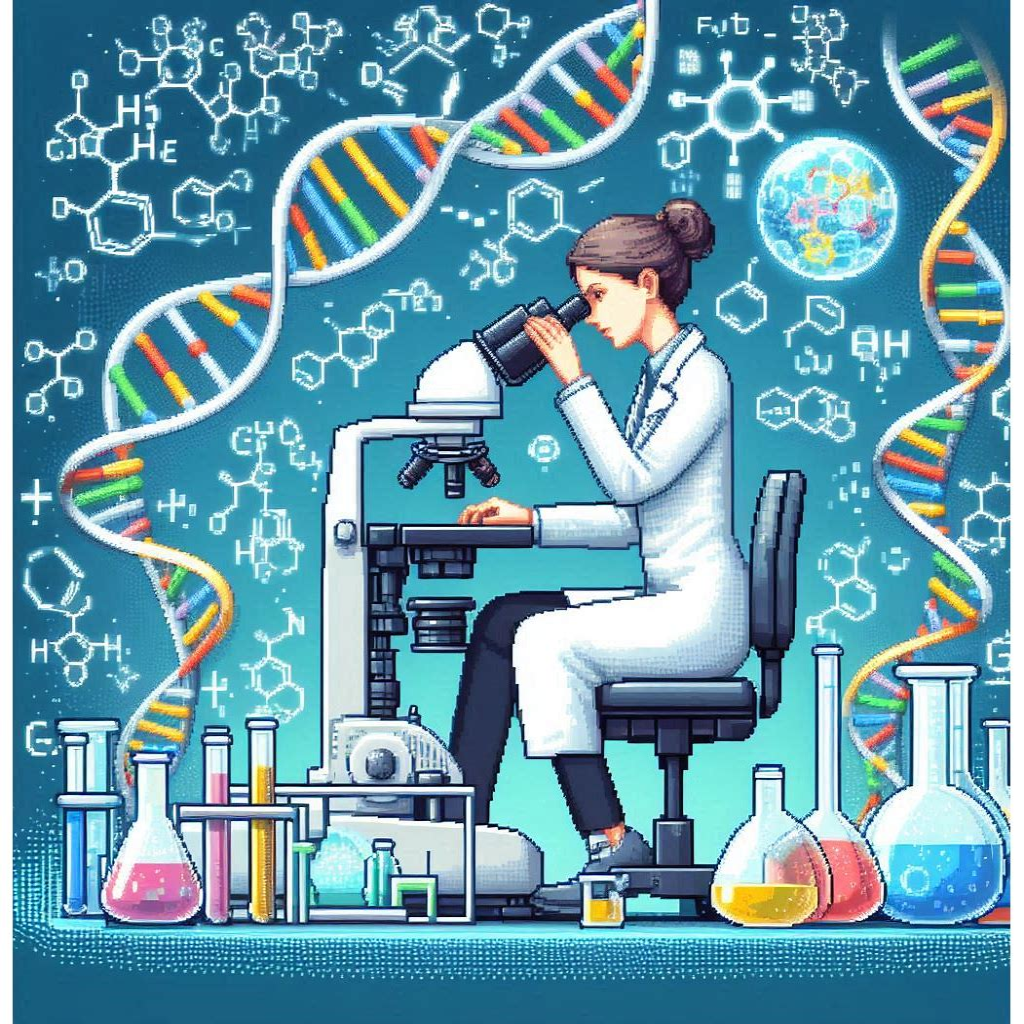
Fig 1: Women using microscope in laboratory. (Image Visually created).

“The sequencing of the Y chromosome is a milestone that sheds light on male genetic diversity and evolutionary history.” – Dr. Chris Tyler-Smith.

1. Introduction:

The human genome is a vast library of genetic information, and each chromosome holds its unique secrets. Among these, the Y chromosome has long intrigued scientists due to its complex structure and critical role in determining male characteristics. Recently, an international research team achieved a remarkable feat: they fully sequenced the Y chromosome, providing unprecedented insights into human biology, evolution, and health.

2. The Y Chromosome: A Tricky Beast:

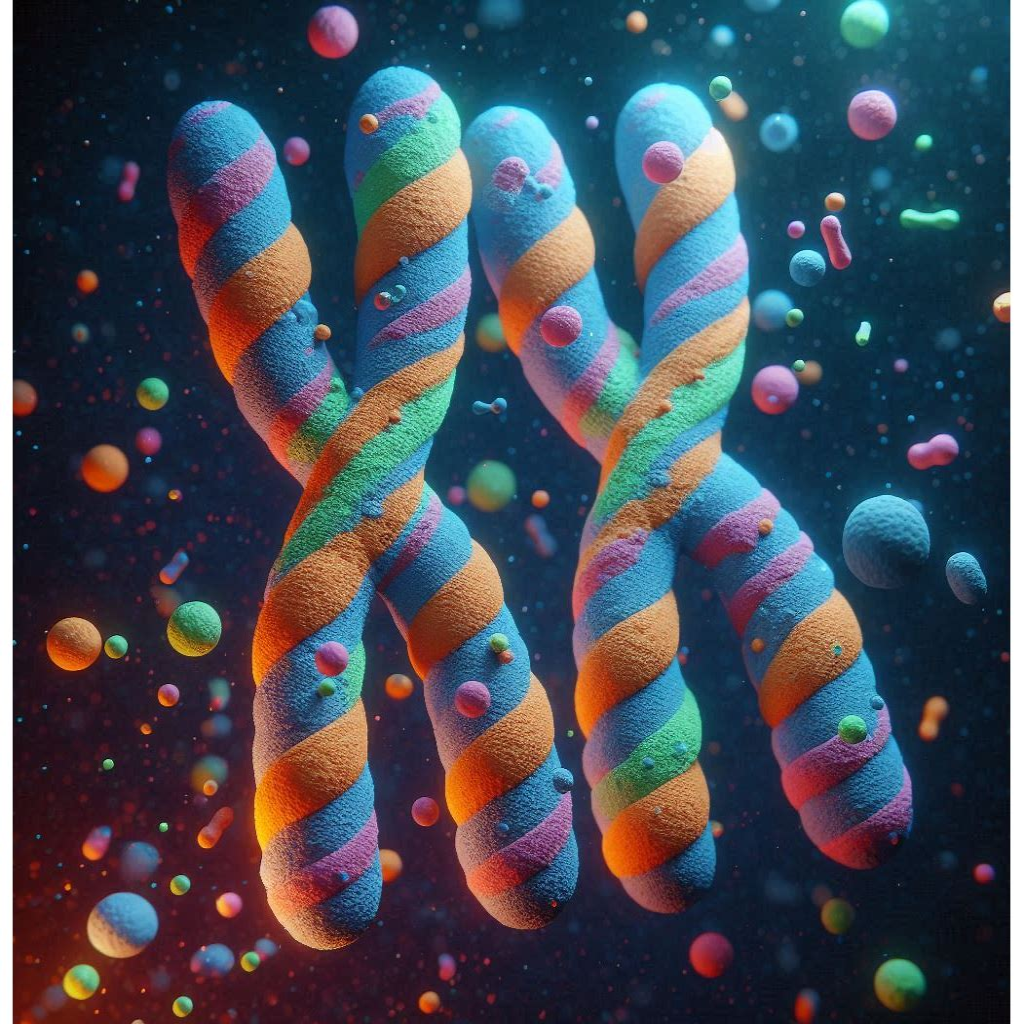
Fig 2: X and Y chromosomes (Image visually created).

2.1. Complexity and Repetition:

  • The Y chromosome has been notoriously difficult to sequence due to its intricate structure.
  • It contains regions that are highly repetitive and densely packed, making it akin to deciphering a cryptic code.[1,2]
  • About 30 million base pairs of the Y chromosome consist of repetitive sequences, which had previously made it extremely challenging to assemble accurately.[1]

2.2. Size and Contribution:

  • Surprisingly, the Y chromosome is one of the smallest in the human genome.
  • It contributes less than 1% of a man’s nuclear DNA. Despite its small size, it plays a crucial role in male development. [1,2]
  • The Y chromosome contains only 107 protein-coding genes, most of which are involved in male sex determination and spermatogenesis (sperm production).

2.3. Variability Among Men:

  • Recent research revealed that the size of the Y chromosome varies significantly between men.
  • In a study of 43 men, Y chromosomes ranged from 45 to 85 million base pairsโ€”some almost twice as long as others. [1,2]
  • This variability accumulates over time, as the Y chromosome is the fastest evolving chromosome in humans. Its rapid evolution can be attributed to the lack of recombination with a homologous chromosome, which allows mutations to accumulate more freely. [2]

2.4. SRY Gene and Sex Determination:

  • The presence or absence of a Y chromosome determines the sex characteristics of a fetus.
  • The SRY gene on the Y chromosome is the master switchโ€”it activates key genes responsible for male development. [2]
  • Individuals inheriting a Y chromosome without SRY may appear female but typically lack functioning ovaries. This can result in conditions such as Swyer syndrome, where an individual has a Y chromosome but develops female characteristics. [2]

3. The Research Team and Timeline:

3.1. Who Did It and When:

  • The full sequencing of the Y chromosome was achieved by the Telomere-to-Telomere (T2T) consortium, a collaboration involving multiple international research institutions. [1,2]
  • The completion of this project was announced in August 2023, marking a significant milestone in genomic research. [3]

3.2. Filling the Gaps:

  • Previous attempts to sequence the Y chromosome were incomplete, leaving significant gaps due to the challenges posed by its repetitive nature. [1]
  • The T2T consortium’s use of advanced sequencing technologies, such as long-read sequencing, allowed them to overcome these challenges and fill in the missing regions, adding approximately 30 million new base pairs to the human genome. [2] ****(Long-read sequencing reads large DNA segments, overcoming repetitive regions and filling gaps, enabling complete Y chromosome assembly, and discovering new genes.)****
  • This comprehensive sequencing effort also uncovered 41 new genes that were previously unidentified, significantly enriching our understanding of the Y chromosome’s genetic landscape. [3,4]

4. Health Implications and Beyond:

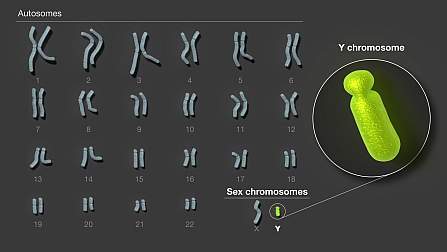
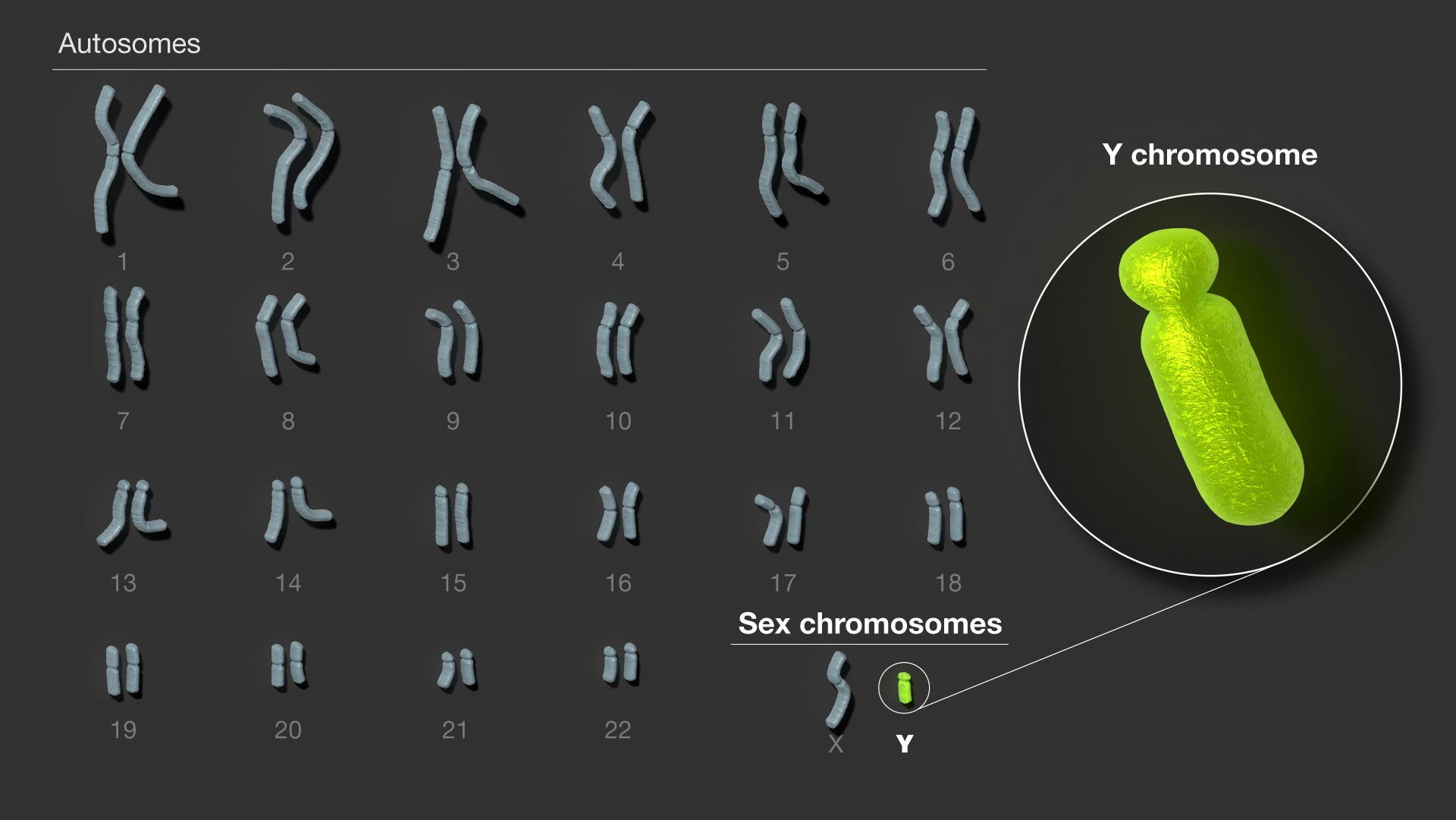
Fig 3: The Y chromosome is the last of the 24 human chromosomes to be completely sequenced. Credit: Darryl Leja, National Human Genome Research Institute (NHGRI).
Image Credit: https://scitechdaily.com/images/Human-Y-Chromosome.jpg

4.1. Fertility Insights:

  • The fully sequenced Y chromosome uncovers genomic features related to fertility, including factors in sperm production.
  • Researchers can now explore male reproductive health with greater precision, potentially addressing infertility issues. [1,2]
  • One key region, known as the azoospermia factor (AZF), is critical for sperm production. The complete sequence allows for more precise analysis of deletions in this region, which are linked to male infertility. [3]

4.2. Correcting Misidentifications:

  • Consensus Building: By sequencing the same regions multiple times and comparing the sequences, errors can be identified and corrected.
  • The new sequence corrects previous misidentifications of bacterial DNA, ensuring accurate reference genomes.
  • This accuracy is crucial for understanding genetic disorders and designing targeted therapies. [1]

4.3. Evolutionary Clues:

  • By studying Y chromosome variations, we gain insights into human evolution and population changes. [3,4]
  • Tracking how the Y chromosome evolved over millennia sheds light on our ancient ancestors’ migrations and interactions. [2]
  • The discovery of 41 new genes and 30 million additional base pairs enriches our understanding of human genetic diversity.[2]

5. How It Was Achieved:

5.1. Long-Read Sequencing:

  • Technology: Used advanced technologies like PacBio (This generates long reads with high accuracy by repeatedly reading the same DNA segment) and Oxford Nanopore (This technology sequences DNA by threading it through tiny pores, allowing for very long reads).
  • Importance: Reads long DNA stretches, essential for decoding repetitive regions of the Y chromosome, which short-read technologies struggle with.[5]

5.2. High-Fidelity Sequencing (HiFi):

  • Process: Involves multiple readings of the same DNA segment for high accuracy.
  • Impact: Reduces errors, crucial for error-prone regions. [5]

5.3. Integrating Data:

  • Platforms: Combined data from PacBio, Oxford Nanopore, and Illumina.
  • Why It Works: Cross-checking and validating sequences ensure accuracy and completeness.[5]

5.4. Bioinformatics Algorithms:

  • Assembly: Tools like Canu or Flye assembled long reads into contigs.
  • Polishing: Tools like Pilon or Racon corrected errors.
  • Repetitive Regions: Specialized algorithms ensured accurate representation.[5]

5.5. Validation:

  • Optical Mapping: This technique creates a physical map of the Y chromosome to compare with the sequence assembly, ensuring structural accuracy.
  • Chromosome Conformation Capture (Hi-C): Provides information about the physical proximity of regions in the chromosome, helping to validate the order and orientation of the sequences.
  • Comparative Genomics: Comparing the newly assembled Y chromosome sequence with those from different individuals or species ensures consistency and accuracy.
  • Ensuring Accuracy: These methods help confirm that the assembled sequence accurately represents the Y chromosome.[5]

6. Key Genes on the Y Chromosome:

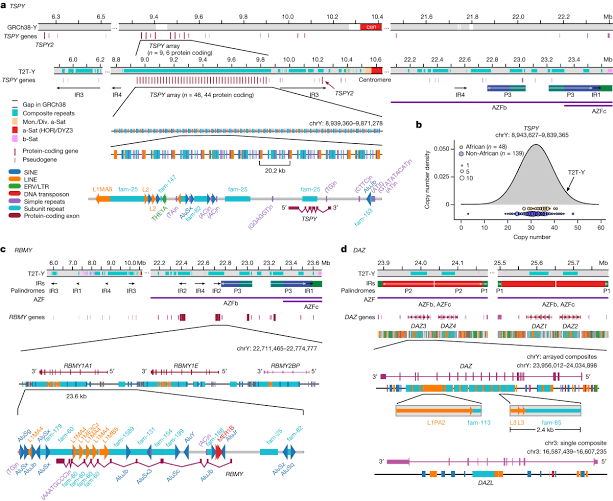
Fig 4: Ampliconic genes forming composite repeats.
Image Credit:https://www.researchgate.net/profile/Reza-Halabian/publication/373348346/figure/fig2/AS:11431281196452493@1696647289617/Ampliconic-genes-forming-composite-repeats-a-T2T-Y-has-44TSPY-protein-coding-genes_Q320.jpg
Image explained:
(a) T2T-Y has 44โ€‰TSPY protein-coding genes, organized in a single continuous array and a single TSPY2 copy, compared with GRCh38-Y which has a gap in the TSPY array. T2T-Y shows a more regularized array and re covers additional TSPY pseudogenes not present in GRCh38-Y.
(b) Copy number differences of TSPY protein-coding copies found in the SGDP.
(c) Repeat composition of the RBMY gene family.
(d) Repeat composition of the DAZ gene family, with one extr a copy annotated on Chr3 that is missing L1PA2. Whereas TSPY and RBMY genes are found within repeat
composites forming arrays, DAZ-associated composites are embedded within the introns of the gene.

6.1. TSPY (Testis-Specific Protein Y-encoded):

  • Function: Produces a protein crucial for spermatogenesis (sperm cell development).
  • Relevance: Important for germ cell regulation and male fertility.

6.2. RBMY (RNA-Binding Motif Protein Y):

  • Function: Encodes RNA-binding proteins vital for sperm development.These proteins are involved in the processing of pre-mRNA (precursor messenger RNA) in spermatogenic cells.
  • Relevance: Mutations can lead to male infertility by affecting sperm production.

6.3. DAZ (Deleted in Azoospermia):

  • Function: Involved in RNA regulation and essential for germ cell development.
  • Relevance: Deletions cause infertility issues like azoospermia (absence of sperm in semen) and oligospermia (low sperm count).

6.4. Study Methodology:

  • Sequencing: Long-read and HiFi sequencing ensured accuracy in repetitive regions.
  • Bioinformatics: Algorithms assembled and polished sequences.

6.5. Findings:

  • Gene Mapping: Precise locations and structures of TSPY, RBMY, and DAZ genes was provided by the complete sequencing of the Y chromosome.
  • Medical Relevance: Better diagnostics and targeted treatments for male infertility.

7. Conclusion:

The Y chromosome, once an enigma, now reveals its secrets. As we delve deeper into its mysteries, we unlock knowledge that impacts medicine, genetics, and our understanding of what it means to be human. From the intricacies of male development to the echoes of our evolutionary past, the Y chromosome continues to captivate scientists and storytellers alike.

8. Reference:

Vancouver Style (๐Ÿ‘ˆClick here)
  1. Scitech Daily. Complete Human Y Chromosome Sequence Assembled for the First Time. SciTechDaily. Published July 2, 2024; Available from: https://scitechdaily.com/complete-human-y-chromosome-sequence-assembled-for-the-first-time/. Accessed July 3, 2024.
  2. SciTechDaily. Y Chromosome Articles. Available from: https://scitechdaily.com/tag/y-chromosome/. Accessed July 3, 2024.
  3. National Institutes of Health. Researchers Assemble First Complete Sequence of Human Y Chromosome. NIH News Releases. Published July 1, 2024; Available from: https://www.nih.gov/news-events/news-releases/researchers-assemble-first-complete-sequence-human-y-chromosome. Accessed July 3, 2024.
  4. SciTechDaily. Y Not? The Full Story Behind Sequencing Humanity’s Most Elusive Chromosome. SciTechDaily. Published July 3, 2024; Available from: https://scitechdaily.com/y-not-the-full-story-behind-sequencing-humanitys-most-elusive-chromosome/. Accessed July 3, 2024.
  5. Rhie A, Nurk S, Cechova M, Hoyt SJ, Taylor DJ, Altemose N, Hook PW, Koren S, Rautiainen M, Alexandrov IA, Allen J, Asri M, Bzikadze AV, Chen NC, Chin CS, Diekhans M, Flicek P, Formenti G, Fungtammasan A, Garcia Giron C, Garrison E, Gershman A, Gerton JL, Grady PGS, Guarracino A, Haggerty L, Halabian R, Hansen NF, Harris R, Hartley GA, Harvey WT, Haukness M, Heinz J, Hourlier T, Hubley RM, Hunt SE, Hwang S, Jain M, Kesharwani RK, Lewis AP, Li H, Logsdon GA, Lucas JK, Makalowski W, Markovic C, Martin FJ, McCartney AM, McCoy RC, McDaniel J, McNulty BM, Medvedev P, Mikheenko A, Munson KM, Murphy TD, Olsen HE, Olson ND, Paulin LF, Porubsky D, Potapova T, Ryabov F, Salzberg SL, Sauria MEG, Sedlazeck FJ, Shafin K, Shepelev VA, Shumate A, Storer JM, Surapaneni L, Taravella Oill AM, Thibaud-Nissen F, Timp W, Tomaszkiewicz M, Vollger MR, Walenz BP, Watwood AC, Weissensteiner MH, Wenger AM, Wilson MA, Zarate S, Zhu Y, Zook JM, Eichler EE, O’Neill RJ, Schatz MC, Miga KH, Makova KD, Phillippy AM. The complete sequence of a human Y chromosome. Nature. 2023 Sep;621(7978):344-354. doi: 10.1038/s41586-023-06457-y. Epub 2023 Aug 23. PMID: 37612512; PMCID: PMC10752217.
Harvard Style (๐Ÿ‘ˆClick here)
  1. SciTech Daily (2024) Complete Human Y Chromosome Sequence Assembled for the First Time. SciTechDaily, 2 July. Available at: https://scitechdaily.com/complete-human-y-chromosome-sequence-assembled-for-the-first-time/ (Accessed: 3 July 2024).
  2. SciTechDaily (n.d.) Y Chromosome Articles. Available at: https://scitechdaily.com/tag/y-chromosome/ (Accessed: 3 July 2024).
  3. National Institutes of Health (2024) Researchers Assemble First Complete Sequence of Human Y Chromosome. Available at: https://www.nih.gov/news-events/news-releases/researchers-assemble-first-complete-sequence-human-y-chromosome (Accessed: 3 July 2024).
  4. SciTechDaily (2024) Y Not? The Full Story Behind Sequencing Humanity’s Most Elusive Chromosome. SciTechDaily. Available at: https://scitechdaily.com/y-not-the-full-story-behind-sequencing-humanitys-most-elusive-chromosome/ (Accessed: 3 July 2024).
  5. Rhie, A., Nurk, S., Cechova, M., Hoyt, S.J., Taylor, D.J., Altemose, N., Hook, P.W., Koren, S., Rautiainen, M., Alexandrov, I.A., Allen, J., Asri, M., Bzikadze, A.V., Chen, N.C., Chin, C.S., Diekhans, M., Flicek, P., Formenti, G., Fungtammasan, A., Garcia Giron, C., โ€ฆ Phillippy, A.M., 2023. The complete sequence of a human Y chromosome. Nature, 621(7978), pp.344-354. Available at: https://doi.org/10.1038/s41586-023-06457-y [Accessed 3 July 2024].
7โ€“11 minutes

Rating: 1 out of 5.

Latest Posts:

Daily writing prompt
On what subject(s) are you an authority?
Posted in Daily Prompt

Not much to say other than Thanks to God…๐Ÿ˜…

What are you most worried about for the future?

Think about today that you are here….Let’s Thank God๐Ÿ™๐Ÿ™…we all don’t know what future is….how it will be the person you see now may not might be the person tomorrow so be your best version today…..

Always thank God for what we are today & pray to God that also the future might be good. Let’s consider everyone as our brothers and sisters….because neither of us are perfect and everyone is depended on others….literally no one is perfect other than God……So let’s pray that may God guide us in right path….I am not here to judge anyone…if any elders here๐Ÿ˜……. this was just my saying…..hope you feel so as well folks!!! Hope you find it helpful & fruitful as well!!

Praise the Lord๐Ÿ™๐Ÿ™

Regards,

Rittu Sara Raju

Have a good day๐Ÿ˜ƒ

“This is my commandment, That ye love one another, as I have loved you.”

John 15:12
Posted in Finance, Business & Marketing

Understanding Global Economic Organizations and Trade Agreements: Key Facts and Examples


Image: https://cdn.dribbble.com/users/1626229/screenshots/4961806/around_the_world_400_300.gif
  1. Introduction
    1. International Monetary Fund (IMF)
    2. World Bank
    3. World Trade Organization (WTO)
    4. Organisation for Economic Co-operation and Development (OECD)
    5. Bank for International Settlements (BIS)
    6. United Nations Conference on Trade and Development (UNCTAD)
  2. Trade Agreements
    1. Free Trade Area (FTA)
    2. Customs Union
    3. Common Market
    4. Economic Union
    5. Political Union
    6. Conclusion

Welcome to the World of Global Economics!!!

1. Introduction

Ever wondered how countries manage their finances, develop infrastructure, or resolve trade disputes? Meet the global economic organizations and trade agreements that make it all happen! These institutions help stabilize economies, fund development projects, and create rules for international trade. Let’s dive into their roles and some real-world examples of their impact.

Ever wondered how countries manage their finances, develop infrastructure, or resolve trade disputes? Meet the global economic organizations and trade agreements that make it all happen! These institutions help stabilize economies, fund development projects, and create rules for international trade. Let’s dive into their roles and some real-world examples of their impact.

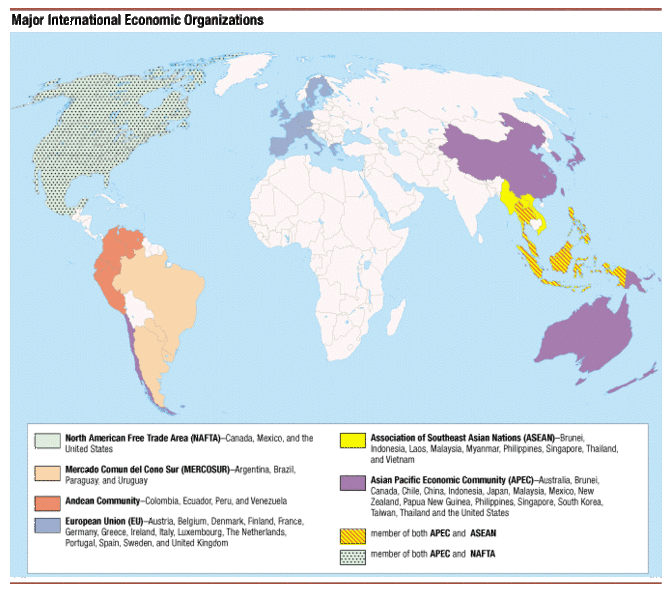
Image: https://upload.wikimedia.org/wikipedia/commons/thumb/7/7e/Major_international_economic_organizations.GIF/671pxMajor_international_economic_organizations.GIF

1.1. International Monetary Fund (IMF)

  • Established: 1944 ๐Ÿฆ
  • Headquarters: Washington, D.C., USA ๐Ÿ‡บ๐Ÿ‡ธ
  • What it does: Helps countries with financial problems ๐Ÿ’ฐ.
  • Example: Greece received loans from the IMF to help it recover from its debt crisis ๐Ÿ“‰.
  • Scenario: In 2010, Greece faced a severe economic crisis, with high levels of debt and a contracting economy. The IMF provided a bailout package worth โ‚ฌ110 billion to prevent default and stabilize the economy, coupled with strict austerity measures and economic reforms.

1.2. World Bank

  • Established: 1944 ๐Ÿฆ
  • Headquarters: Washington, D.C., USA ๐Ÿ‡บ๐Ÿ‡ธ
  • What it does: Funds development projects in poor countries ๐ŸŒ.
  • Example: The World Bank funded a new highway in Kenya to improve transportation ๐Ÿšง.
  • Scenario: In 2011, the World Bank approved $300 million to improve Kenya’s transport sector through the construction of the Northern Corridor Transport Improvement Project. This highway facilitated trade and movement, reducing travel time and costs for goods and people.

1.3. World Trade Organization (WTO)

  • Established: 1995 ๐Ÿข (succeeded GATT, established in 1948)
  • Headquarters: Geneva, Switzerland ๐Ÿ‡จ๐Ÿ‡ญ
  • What it does: Manages global trade rules and disputes ๐ŸŒ.
  • Example: The WTO resolved a trade dispute between the USA and China over tariffs on electronics ๐Ÿ“ฆ.
  • Scenario: In 2019, the WTO ruled in favor of the EU in a dispute with the USA over subsidies to aircraft manufacturers Boeing and Airbus. The WTO allowed the EU to impose tariffs on $7.5 billion worth of US goods in response to illegal subsidies given to Boeing.

1.4. Organisation for Economic Co-operation and Development (OECD)

  • Established: 1961 ๐Ÿ›๏ธ
  • Headquarters: Paris, France ๐Ÿ‡ซ๐Ÿ‡ท
  • What it does: Advises countries on economic policies ๐Ÿ“Š.
  • Example: The OECD advised Mexico on how to improve its education system to boost economic growth ๐Ÿ“š.
  • Scenario: In 2018, the OECD published a report on Mexico’s education system, recommending reforms to improve teacher quality and student outcomes. These recommendations aimed at reducing inequalities and enhancing skills to support economic growth.

1.5. Bank for International Settlements (BIS)

  • Established: 1930 ๐Ÿฆ
  • Headquarters: Basel, Switzerland ๐Ÿ‡จ๐Ÿ‡ญ
  • What it does: Supports central banks and ensures financial stability ๐Ÿ’น.
  • Example: The BIS helped central banks coordinate during the 2008 financial crisis to stabilize global markets ๐Ÿ“‰.
  • Scenario: During the 2008 financial crisis, the BIS facilitated communication among central banks, helping to coordinate measures such as interest rate cuts and liquidity support. This cooperation was crucial in preventing a complete collapse of the global financial system.

1.6. United Nations Conference on Trade and Development (UNCTAD)

  • Established: 1964 ๐Ÿข
  • Headquarters: Geneva, Switzerland ๐Ÿ‡จ๐Ÿ‡ญ
  • What it does: Assists developing countries in global trade ๐Ÿ“ˆ.
  • Example: UNCTAD helped Vietnam improve its trade regulations, attracting more foreign businesses ๐ŸŒ.
  • Scenario: In the early 2000s, UNCTAD worked with Vietnam to modernize its trade policies and regulations. This assistance was part of broader reforms that helped Vietnam join the WTO in 2007, significantly boosting its trade and economic growth.

2. Trade Agreements

2.1. Free Trade Area (FTA)

  • What it is: Countries remove tariffs on goods traded between them ๐Ÿ“ฆ.
  • Example: NAFTA ๐Ÿ‡บ๐Ÿ‡ธ๐Ÿ‡จ๐Ÿ‡ฆ๐Ÿ‡ฒ๐Ÿ‡ฝ (USA, Canada, Mexico)
  • Purpose: No tariffs on goods traded among these countries ๐Ÿšซ.
  • Scenario: Under NAFTA, the trade of agricultural products between the US, Canada, and Mexico increased significantly. For example, US corn exports to Mexico more than tripled, benefiting American farmers and Mexican consumers with lower prices.

2.2. Customs Union

  • What it is: An FTA plus a common trade policy with non-members ๐Ÿ“‘.
  • Example: Mercosur ๐Ÿ‡ฆ๐Ÿ‡ท๐Ÿ‡ง๐Ÿ‡ท๐Ÿ‡ต๐Ÿ‡พ๐Ÿ‡บ๐Ÿ‡พ (Argentina, Brazil, Paraguay, Uruguay)
  • Purpose: Free trade among members and same tariffs on goods from outside ๐ŸŒ.
  • Scenario: Mercosur countries enjoy duty-free trade with each other while applying a common external tariff to non-member countries. This arrangement helps protect local industries while fostering regional trade.

2.3. Common Market

  • What it is: A customs union plus free movement of people and money ๐Ÿ’ถ.
  • Example: European Economic Area (EEA) ๐Ÿ‡ช๐Ÿ‡บ๐Ÿ‡ฎ๐Ÿ‡ธ๐Ÿ‡ฑ๐Ÿ‡ฎ๐Ÿ‡ณ๐Ÿ‡ด (EU countries, Iceland, Liechtenstein, Norway)
  • Purpose: Free movement of goods, services, people, and capital ๐Ÿ”„.
  • Scenario: Within the EEA, citizens can live and work in any member country. For instance, a Norwegian engineer can easily find employment in Germany without needing a work permit, benefiting both the individual and the economies of both countries.

2.4. Economic Union

  • What it is: A common market plus coordinated economic policies ๐Ÿ“‹.
  • Example: European Union (EU) ๐Ÿ‡ช๐Ÿ‡บ
  • Members: 27 European countries
  • Purpose: Shared market and policies, some use the Euro (โ‚ฌ).
  • Scenario: The EU coordinates policies on various economic issues such as agriculture and regional development. The adoption of the Euro by 19 member countries simplifies transactions and travel, enhancing economic integration.

2.5. Political Union

  • What it is: An economic union plus political integration ๐Ÿ›๏ธ.
  • Example: EU (moving towards this) ๐Ÿ‡ช๐Ÿ‡บ
  • Purpose: Shared institutions and partial political integration ๐Ÿ›๏ธ.
  • Scenario: The EU has its own parliament and judiciary, and member states work together on many policies, including foreign affairs and security. This level of integration aims to create a more unified and strong political entity on the global stage.

3. Conclusion

๐ŸŒWrapping Up the World of Global Economics!! Global economic organizations and trade agreements are the backbone of international cooperation and economic stability. They provide crucial support during financial crises, fund essential development projects, and manage trade rules and disputes. Understanding these entities helps us grasp the complexities of the global economy and the efforts to achieve stability, growth, and prosperity. Through teamwork and shared goals, these institutions and agreements build a more connected and resilient world economy. So, next time you hear about a financial crisis or a new trade deal, you’ll know who’s behind the scenes making it all work!


Click here for Malayalam Translation๐Ÿ‘ˆ


เดฒเต‹เด• เด†เดฐเตโ€เดฅเดฟเด• เดธเด‚เด˜เดŸเดจเด•เดณเตเด‚ เดตเตเดฏเดพเดชเดพเดฐ เด‰เดŸเดฎเตเดชเดŸเดฟเด•เดณเตเด‚

๐ŸŒ เดฒเต‹เด•เด‚ เด†เดฐเตโ€เดฅเดฟเด• เดตเดฟเดถเดพเดฒเดคเดฏเดฟเดฒเต‡เด•เตเด•เต เดธเตเดตเดพเด—เดคเด‚! ๐ŸŒ

เดฐเดพเดœเตเดฏเด™เตเด™เดณเตโ€ เดŽเด™เตเด™เดจเต† เด…เดตเดฐเตเดŸเต† เดงเดจเด•เดพเดฐเตเดฏเด™เตเด™เดณเตโ€ เด•เตˆเด•เดพเดฐเตเดฏเด‚ เดšเต†เดฏเตเดฏเตเดจเตเดจเต, เด…เดŸเดฟเดธเตเดฅเดพเดจเดธเต—เด•เดฐเตเดฏเด™เตเด™เดณเตโ€ เดตเดฟเด•เดธเดฟเดชเตเดชเดฟเด•เตเด•เตเดจเตเดจเต, เด…เดฒเตเดฒเต†เด™เตเด•เดฟเดฒเตโ€ เดตเตเดฏเดพเดชเดพเดฐ เดตเดฟเดตเดพเดฆเด™เตเด™เดณเตโ€ เดชเดฐเดฟเดนเดฐเดฟเด•เตเด•เตเดจเตเดจเต เดŽเดจเตเดจเต เดŽเดชเตเดชเต‹เดดเต†เด™เตเด•เดฟเดฒเตเด‚ เดšเดฟเดจเตเดคเดฟเดšเตเดšเดฟเดŸเตเดŸเตเดฃเตเดŸเต‹? เด‡เดคเต†เดฒเตเดฒเดพเด‚ เดจเดŸเดชเตเดชเดพเด•เตเด•เตเดจเตเดจ เด†เด—เต‹เดณ เด†เดฐเตโ€เดฅเดฟเด• เดธเด‚เด˜เดŸเดจเด•เดณเตเด‚ เดตเตเดฏเดพเดชเดพเดฐ เด‰เดŸเดฎเตเดชเดŸเดฟเด•เดณเตเด‚ เดชเดฐเดฟเดšเดฏเดชเตเดชเต†เดŸเต‚! เดˆ เดธเตเดฅเดพเดชเดจเด™เตเด™เดณเตโ€ เด†เดฐเตโ€เดฅเดฟเด•เด™เตเด™เดณเต† เดธเตเดฅเดฟเดฐเดคเดฏเดพเด•เตเด•เดพเดจเตเด‚, เดตเดฟเด•เดธเดจ เดชเดฆเตเดงเดคเดฟเด•เดณเตโ€เด•เตเด•เต เดงเดจเด‚ เดจเดฒเตโ€เด•เดพเดจเตเด‚, เด…เดจเตเดคเดพเดฐเดพเดทเตเดŸเตเดฐ เดตเตเดฏเดพเดชเดพเดฐเดคเตเดคเดฟเดจเตเดณเตเดณ เดจเดฏเด™เตเด™เดณเตโ€ เดธเตƒเดทเตเดŸเดฟเด•เตเด•เดพเดจเตเดฎเดพเดฃเต เดธเดนเดพเดฏเดฟเด•เตเด•เตเดจเตเดจเดคเต. เด…เดตเดฐเตเดŸเต† เดชเด™เตเด•เตเด‚ เด…เดตเดฐเตเดŸเต† เดธเตเดตเดพเดงเต€เดจเด‚ เด•เดพเดฃเดฟเด•เตเด•เตเดจเตเดจ เดšเดฟเดฒ เดฏเดฅเดพเดฐเตโ€เดฅ เด‰เดฆเดพเดนเดฐเดฃเด™เตเด™เดณเตเด‚ เดชเดฐเดฟเดถเต‹เดงเดฟเด•เตเด•เดพเด‚.

เด…เดจเตเดคเดพเดฐเดพเดทเตเดŸเตเดฐ เดจเดฟเดงเดฟ เดจเดฟเดงเดฟ (เดเดŽเด‚เดŽเดซเต)

  • เดธเตเดฅเดพเดชเดฟเดšเตเดšเดคเต: 1944 ๐Ÿฆ
  • เดนเต†เดกเตโ€Œเด•เตเดตเดพเดฐเตโ€เดŸเตเดŸเดฐเตโ€เดธเต: เดตเดพเดทเดฟเด‚เด—เตเดŸเดฃเตโ€ เดกเดฟ.เดธเดฟ., เดฏเต.เดŽเดธเต.เดŽ ๐Ÿ‡บ๐Ÿ‡ธ
  • เดšเต†เดฏเตเดฏเตเดจเตเดจเดคเต: เดฐเดพเดœเตเดฏเด™เตเด™เดณเตเดŸเต† เดธเดพเดฎเตเดชเดคเตเดคเดฟเด• เดชเตเดฐเดถเตโ€Œเดจเด™เตเด™เดณเตโ€เด•เตเด•เต เดธเดนเดพเดฏเด‚ เดจเดฒเตโ€เด•เตเดจเตเดจเต ๐Ÿ’ฐ.
  • เด‰เดฆเดพเดนเดฐเดฃเด‚: เด—เตเดฐเต€เดธเต เด…เดตเดฐเตเดŸเต† เด•เดŸเดฌเดพเดงเตเดฏเดคเดพ เดชเตเดฐเดคเดฟเดธเดจเตเดงเดฟ เดฎเดพเดฑเดพเดจเดพเดฏเดฟ เดเดŽเด‚เดŽเดซเดฟเดฒเตโ€ เดจเดฟเดจเตเดจเตเด‚ เดตเดพเดฏเตเดชเด•เดณเตโ€ เดจเต‡เดŸเดฟ ๐Ÿ“‰.
  • เดธเด‚เดญเดตเด‚: 2010-เดฒเตโ€, เด—เตเดฐเต€เดธเต เด—เต—เดฐเดตเดฎเดพเดฏ เดธเดพเดฎเตเดชเดคเตเดคเดฟเด• เดชเตเดฐเดคเดฟเดธเดจเตเดงเดฟ เดจเต‡เดฐเดฟเดŸเตเด•เดฏเดพเดฏเดฟเดฐเตเดจเตเดจเต, เด‰เดฏเตผเดจเตเดจ เด•เดŸเดฌเดพเดงเตเดฏเดคเดฏเตเด‚ เดšเตเดฐเตเด™เตเด™เตเดจเตเดจ เดธเดพเดฎเตเดชเดคเตเดคเดฟเด•เดตเตเดฎเดพเดฏ. เดเดŽเด‚เดŽเดซเต เดกเดฟเดซเต‹เดณเตโ€เดŸเตเดŸเดฟเดจเต† เดคเดŸเดฏเดพเดจเตเด‚ เดธเดพเดฎเตเดชเดคเตเดคเดฟเด•เดคเตเดคเดฟเดจเต† เดธเตเดฅเดฟเดฐเดคเดฏเดพเด•เตเด•เดพเดจเตเด‚ โ‚ฌ110 เดฌเดฟเดฒเตเดฒเตเดฏเดฃเตโ€ เดฎเต‚เดฒเตเดฏเดฎเตเดณเตเดณ เดฐเด•เตเดทเดพเดชเดพเด•เตเด•เต‡เดœเต เดจเดฒเตโ€เด•เดฟ, เด•เด เดฟเดจเดฎเดพเดฏ เดฎเดฟเดคเดตเตเดฏเดฏ เดจเดŸเดชเดŸเดฟเด•เดณเตเด‚ เดธเดพเดฎเตเดชเดคเตเดคเดฟเด• เดชเตเดจเดฐเตโ€เดตเดฟเดจเตเดฏเดพเดธเด™เตเด™เดณเตเด‚ เด‰เดณเตโ€เดชเตเดชเต†เดŸเต†.

เดฒเต‹เด• เดฌเดพเด™เตเด•เต

  • เดธเตเดฅเดพเดชเดฟเดšเตเดšเดคเต: 1944 ๐Ÿฆ
  • เดนเต†เดกเตโ€Œเด•เตเดตเดพเดฐเตโ€เดŸเตเดŸเดฐเตโ€เดธเต: เดตเดพเดทเดฟเด‚เด—เตเดŸเดฃเตโ€ เดกเดฟ.เดธเดฟ., เดฏเต.เดŽเดธเต.เดŽ ๐Ÿ‡บ๐Ÿ‡ธ
  • เดšเต†เดฏเตเดฏเตเดจเตเดจเดคเต: เดฆเดฐเดฟเดฆเตเดฐ เดฐเดพเดœเตเดฏเด™เตเด™เดณเดฟเดฒเตโ€ เดตเดฟเด•เดธเดจ เดชเดฆเตเดงเดคเดฟเด•เดณเตโ€เด•เตเด•เต เดงเดจเด‚ เดจเดฒเตโ€เด•เตเดจเตเดจเต ๐ŸŒ.
  • เด‰เดฆเดพเดนเดฐเดฃเด‚: เด•เต†เดจเดฟเดฏเดฏเดฟเดฒเต† เดชเตเดคเดฟเดฏ เดนเตˆเดตเต‡เดฏเตเดŸเต† เดตเดฟเด•เดธเดจเดคเตเดคเดฟเดจเต เดฒเต‹เด• เดฌเดพเด™เตเด•เต เดงเดจเด‚ เดจเดฒเตโ€เด•เดฟ ๐Ÿšง.
  • เดธเด‚เดญเดตเด‚: 2011-เดฒเตโ€, เดฒเต‹เด• เดฌเดพเด™เตเด•เต เด•เต†เดจเดฟเดฏเดฏเตเดŸเต† เด—เดคเดพเด—เดค เดฎเต‡เด–เดฒ เดฎเต†เดšเตเดšเดชเตเดชเต†เดŸเตเดคเตเดคเตเดจเตเดจเดคเดฟเดจเต $300 เดฎเดฟเดฒเตเดฒเตเดฏเดฃเตโ€ เด…เดจเตเดตเดฆเดฟเดšเตเดšเต. เดˆ เดนเตˆเดตเต‡ เดตเตเดฏเดพเดชเดพเดฐเดตเตเด‚ เดฏเดพเดคเตเดฐเด•เดณเตเด‚ เดฎเต†เดšเตเดšเดชเตเดชเต†เดŸเตเดคเตเดคเตเด•เดฏเตเด‚, เดšเดฐเด•เตเด•เตเด•เดณเตเด‚ เด†เดณเตเด•เดณเตเด‚ เดŽเดคเตเดคเดฟเด•เตเด•เตเดจเตเดจเดคเดฟเดจเต เดธเดฎเดฏเดตเตเด‚ เดšเต†เดฒเดตเตเด‚ เด•เตเดฑเดฏเตเด•เตเด•เตเด•เดฏเตเด‚ เดšเต†เดฏเตเดคเต.

เดฒเต‹เด• เดตเตเดฏเดพเดชเดพเดฐ เดธเด‚เด˜เดŸเดจ (เดกเดฌเตเดฒเตเดฏเตเดŸเดฟเด’)

  • เดธเตเดฅเดพเดชเดฟเดšเตเดšเดคเต: 1995 ๐Ÿข (1948-เดฒเตโ€ เดธเตเดฅเดพเดชเดฟเดคเดฎเดพเดฏ เดœเดพเดฑเตเดฑเดฟเดจเต เดชเด•เดฐเดฎเดพเดฏเดฟ)
  • เดนเต†เดกเตโ€Œเด•เตเดตเดพเดฐเตโ€เดŸเตเดŸเดฐเตโ€เดธเต: เดœเต†เดจเต€เดต, เดธเตเดตเดฟเดฑเตเดฑเตเดธเดฐเตโ€เดฒเดจเตโ€เดกเต ๐Ÿ‡จ๐Ÿ‡ญ
  • เดšเต†เดฏเตเดฏเตเดจเตเดจเดคเต: เด†เด—เต‹เดณ เดตเตเดฏเดพเดชเดพเดฐ เดจเดฟเดฏเดฎเด™เตเด™เดณเตเด‚ เดตเดฟเดตเดพเดฆเด™เตเด™เดณเตเด‚ เดจเดฟเดฏเดจเตเดคเตเดฐเดฟเด•เตเด•เตเดจเตเดจเต ๐ŸŒ.
  • เด‰เดฆเดพเดนเดฐเดฃเด‚: เดฏเต.เดŽเดธเต.เดฏเตเด‚ เดšเตˆเดจเดฏเตเด‚ เดคเดฎเตเดฎเดฟเดฒเตเดณเตเดณ เด‡เดฒเด•เตเดŸเตเดฐเต‹เดฃเดฟเด•เตเดธเต เดจเดฟเด•เตเดคเดฟ เดธเด‚เดฌเดจเตเดงเดฟเดšเตเดš เดตเตเดฏเดพเดชเดพเดฐ เดตเดฟเดตเดพเดฆเด‚ เดกเดฌเตเดฒเตเดฏเตเดŸเดฟเด’ เดชเดฐเดฟเดนเดฐเดฟเดšเตเดšเต ๐Ÿ“ฆ.
  • เดธเด‚เดญเดตเด‚: 2019-เดฒเตโ€, เดŽเดฏเดฐเตโ€เด•เตเดฐเดพเดซเตเดฑเตเดฑเต เดจเดฟเดฐเตโ€เดฎเตเดฎเดพเดคเดพเด•เตเด•เดณเดพเดฏ เดฌเต‹เดฏเดฟเด‚เด—เต, เดŽเดฏเดฐเตโ€เดฌเดธเต เดŽเดจเตเดจเดฟเดตเดฏเตเด•เตเด•เต เดจเดฟเด•เตเดคเดฟ เดจเดฒเตโ€เด•เตเดจเตเดจเดคเดฟเดจเต†เด•เตเด•เตเดฑเดฟเดšเตเดšเตเดณเตเดณ เดฏเต.เดŽเดธเต.เดฏเตเดฎเดพเดฏเตเดณเตเดณ เดตเดฟเดตเดพเดฆเดคเตเดคเดฟเดฒเตโ€ เด‡.เดฏเต.เด•เตเด•เต เด…เดจเตเด•เต‚เดฒเดฎเดพเดฏเดฟ เดกเดฌเตเดฒเตเดฏเตเดŸเดฟเด’ เดตเดฟเดงเดฟ เดชเตเดฑเดชเตเดชเต†เดŸเตเดตเดฟเดšเตเดšเต. เดฌเต‹เดฏเดฟเด‚เด—เดฟเดจเต เดฒเดญเดฟเดšเตเดš เด…เดจเดงเดฟเด•เตƒเดค เดธเดฌเตเดธเดฟเดกเดฟเด•เดณเตเดŸเต† เดชเตเดฐเดคเดฟเด•เดฐเดฃเดฎเดพเดฏเดฟ $7.5 เดฌเดฟเดฒเตเดฒเตเดฏเดฃเตโ€ เดฎเต‚เดฒเตเดฏเดฎเตเดณเตเดณ เดฏเต.เดŽเดธเต. เดธเดพเดงเดจเด™เตเด™เดณเตโ€เด•เตเด•เต เดจเดฟเด•เตเดคเดฟ เดจเดฒเตโ€เด•เดพเดจเตโ€ เดกเดฌเตเดฒเตเดฏเตเดŸเดฟเด’ เด…เดจเตเดฎเดคเดฟ เดจเดฒเตโ€เด•เดฟ.

เด†เดฐเตโ€เดฅเดฟเด• เดธเดนเด•เดฐเดฃ เดตเดฟเด•เดธเดจ เดธเด‚เด˜เดŸเดจ (เด’เด‡เดธเดฟเดกเดฟ)

  • เดธเตเดฅเดพเดชเดฟเดšเตเดšเดคเต: 1961 ๐Ÿ›๏ธ
  • เดนเต†เดกเตโ€Œเด•เตเดตเดพเดฐเตโ€เดŸเตเดŸเดฐเตโ€เดธเต: เดชเดพเดฐเดฟเดธเต, เดซเตเดฐเดพเดจเตโ€เดธเต ๐Ÿ‡ซ๐Ÿ‡ท
  • เดšเต†เดฏเตเดฏเตเดจเตเดจเดคเต: เดฐเดพเดœเตเดฏเด™เตเด™เดณเต† เดธเดพเดฎเตเดชเดคเตเดคเดฟเด• เดจเดฏเด™เตเด™เดณเตโ€ เดธเด‚เดฌเดจเตเดงเดฟเดšเตเดšเต เด‰เดชเดฆเต‡เดถเดฟเด•เตเด•เตเดจเตเดจเต ๐Ÿ“Š.
  • เด‰เดฆเดพเดนเดฐเดฃเด‚: เดฎเต†เด•เตเดธเดฟเด•เตเด•เต‹เดฏเตเดŸเต† เดตเดฟเดฆเตเดฏเดพเดญเตเดฏเดพเดธ เดธเดฎเตเดชเตเดฐเดฆเดพเดฏเด‚ เดฎเต†เดšเตเดšเดชเตเดชเต†เดŸเตเดคเตเดคเดพเดจเตเด‚, เดธเดพเดฎเตเดชเดคเตเดคเดฟเด• เดตเดณเดฐเตโ€เดšเตเดšเดฏเต† เด‰เดคเตเดคเต‡เดœเดฟเดชเตเดชเดฟเด•เตเด•เดพเดจเตเด‚ เด’เด‡เดธเดฟเดกเดฟ เด‰เดชเดฆเต‡เดถเด‚ เดจเดฒเตโ€เด•เดฟ ๐Ÿ“š.
  • เดธเด‚เดญเดตเด‚: 2018-เดฒเตโ€, เด’เด‡เดธเดฟเดกเดฟ เดฎเต†เด•เตเดธเดฟเด•เตเด•เต‹เดฏเตเดŸเต† เดตเดฟเดฆเตเดฏเดพเดญเตเดฏเดพเดธ เดธเดฎเตเดชเตเดฐเดฆเดพเดฏเดคเตเดคเต† เด•เตเดฑเดฟเดšเตเดšเต เด’เดฐเต เดฑเดฟเดชเตเดชเต‹เดฐเตโ€เดŸเตเดŸเต เดชเตเดฐเดธเดฟเดฆเตเดงเต€เด•เดฐเดฟเดšเตเดšเต, เด…เดงเตเดฏเดพเดชเด• เด—เตเดฃเดจเดฟเดฒเดตเดพเดฐเดตเตเด‚ เดตเดฟเดฆเตเดฏเดพเดฐเตโ€เดฅเดฟ เดซเดฒเด™เตเด™เดณเตเด‚ เดฎเต†เดšเตเดšเดชเตเดชเต†เดŸเตเดคเตเดคเตเดจเตเดจเดคเดฟเดจเตเดณเตเดณ เดชเตเดจเดฐเตโ€เดตเดฟเดจเตเดฏเดพเดธเด™เตเด™เดณเตโ€ เดถเตเดชเดพเดฐเตโ€เดถ เดšเต†เดฏเตเดคเต. เดˆ เดถเตเดชเดพเดฐเตโ€เดถเด•เดณเตโ€ เด…เดธเดฎเดคเตเดตเด‚ เด•เตเดฑเดฏเตเด•เตเด•เดพเดจเตเด‚ เดธเดพเดฎเตเดชเดคเตเดคเดฟเด• เดตเดณเดฐเตโ€เดšเตเดšเดฏเต† เดชเดฟเดจเตเดคเตเดฃเดฏเตเด•เตเด•เดพเดจเตเด‚ เด‰เดฆเตเดฆเต‡เดถเดฟเดšเตเดšเต.

เด…เดจเตเดคเดพเดฐเดพเดทเตเดŸเตเดฐ เดจเดฟเด•เตเดทเต‡เดช เดฌเดพเด™เตเด•เต (BIS)

  • เดธเตเดฅเดพเดชเดฟเดšเตเดšเดคเต: 1930 ๐Ÿฆ
  • เดนเต†เดกเตโ€Œเด•เตเดตเดพเดฐเตโ€เดŸเตเดŸเดฐเตโ€เดธเต: เดฌเดพเดธเดฒเตโ€, เดธเตเดตเดฟเดฑเตเดฑเตเดธเดฐเตโ€เดฒเดจเตโ€เดกเต ๐Ÿ‡จ๐Ÿ‡ญ
  • เดšเต†เดฏเตเดฏเตเดจเตเดจเดคเต: เด•เต‡เดจเตเดฆเตเดฐ เดฌเดพเด™เตเด•เตเด•เดณเตโ€เด•เตเด•เต เดชเดฟเดจเตเดคเตเดฃ เดจเดฒเตโ€เด•เตเดจเตเดจเต, เดธเดพเดฎเตเดชเดคเตเดคเดฟเด• เดธเตเดฅเดฟเดฐเดค เด‰เดฑเดชเตเดชเดพเด•เตเด•เตเดจเตเดจเต ๐Ÿ’น.
  • เด‰เดฆเดพเดนเดฐเดฃเด‚: 2008 เดธเดพเดฎเตเดชเดคเตเดคเดฟเด• เดชเตเดฐเดคเดฟเดธเดจเตเดงเดฟ เดธเดฎเดฏเดคเตเดคเต BIS เด•เต‡เดจเตเดฆเตเดฐ เดฌเดพเด™เตเด•เตเด•เดณเต† เดธเดนเด•เดฐเดฟเดชเตเดชเดฟเดšเตเดšเต, เด†เด—เต‹เดณ เดตเดฟเดชเดฃเดฟเด•เดณเต† เดธเตเดฅเดฟเดฐเดคเดฏเดพเด•เตเด•เตเดจเตเดจเต ๐Ÿ“‰.
  • เดธเด‚เดญเดตเด‚: 2008 เดธเดพเดฎเตเดชเดคเตเดคเดฟเด• เดชเตเดฐเดคเดฟเดธเดจเตเดงเดฟ เดธเดฎเดฏเดคเตเดคเต BIS เด•เต‡เดจเตเดฆเตเดฐ เดฌเดพเด™เตเด•เตเด•เดณเตโ€เด•เตเด•เต เดคเดฎเตเดฎเดฟเดฒเตเดณเตเดณ เด†เดถเดฏเดตเดฟเดจเดฟเดฎเดฏเด‚ เดŽเดณเตเดชเตเดชเดฎเดพเด•เตเด•เดฟ, เดชเดฒเดฟเดถ เดจเดฟเดฐเด•เตเด•เต เด•เตเดฑเด•เตเด•เดฒเตโ€, เดฆเตเดฐเดพเดตเด•เดคเตเดต เดชเดฟเดจเตเดคเตเดฃ เดชเต‹เดฒเตเดณเตเดณ เดจเดŸเดชเดŸเดฟเด•เดณเตโ€ เด•เต‹เดฐเตโ€เดกเดฟเดจเต‡เดฑเตเดฑเต เดšเต†เดฏเตเดคเต. เดˆ เดธเดนเด•เดฐเดฃเด‚ เด†เด—เต‹เดณ เดธเดพเดฎเตเดชเดคเตเดคเดฟเด• เดตเตเดฏเดตเดธเตเดฅเดฏเตเดŸเต† เดชเต‚เดฐเตโ€เดฃ เดคเด•เดฐเตโ€เดšเตเดšเดฏเต† เดคเดŸเดฏเดพเดจเตโ€ เดจเดฟเดฐเตโ€เดฃเดพเดฏเด•เดฎเดพเดฏเดฟเดฐเตเดจเตเดจเต.

เดฏเตเดŽเดจเตโ€ เดตเตเดฏเดพเดชเดพเดฐเดตเตเด‚ เดตเดฟเด•เดธเดจเดตเตเด‚ เดธเด‚เดฌเดจเตเดงเดฟเดšเตเดš เดธเดฎเตเดฎเต‡เดณเดจเด‚ (UNCTAD)

  • เดธเตเดฅเดพเดชเดฟเดšเตเดšเดคเต: 1964 ๐Ÿข
  • เดนเต†เดกเตโ€Œเด•เตเดตเดพเดฐเตโ€เดŸเตเดŸเดฐเตโ€เดธเต: เดœเต†เดจเต€เดต, เดธเตเดตเดฟเดฑเตเดฑเตเดธเดฐเตโ€เดฒเดจเตโ€เดกเต ๐Ÿ‡จ๐Ÿ‡ญ
  • เดšเต†เดฏเตเดฏเตเดจเตเดจเดคเต: เดตเดฟเด•เดธเดจ เดฐเดพเดœเตเดฏเด™เตเด™เดณเดฟเดฒเต† เด†เด—เต‹เดณ เดตเตเดฏเดพเดชเดพเดฐเดคเตเดคเดฟเดจเต เดธเดนเดพเดฏเดฟเด•เตเด•เตเดจเตเดจเต ๐Ÿ“ˆ.
  • เด‰เดฆเดพเดนเดฐเดฃเด‚: UNCTAD เดตเดฟเดฏเดฑเตเดฑเตเดจเดพเดฎเดฟเดจเตเดฑเต† เดตเตเดฏเดพเดชเดพเดฐ เดจเดฟเดฏเดฎเด™เตเด™เดณเตโ€ เดฎเต†เดšเตเดšเดชเตเดชเต†เดŸเตเดคเตเดคเดพเดจเตเด‚, เด•เต‚เดŸเตเดคเดฒเตโ€ เดตเดฟเดฆเต‡เดถ เดฌเดฟเดธเดฟเดจเดธเตเด•เดณเต† เด†เด•เดฐเตโ€เดทเดฟเด•เตเด•เดพเดจเตเด‚ เดธเดนเดพเดฏเดฟเดšเตเดšเต ๐ŸŒ.
  • เดธเด‚เดญเดตเด‚: 2000-เด•เดณเตเดŸเต† เด†เดฆเตเดฏเด‚, UNCTAD เดตเดฟเดฏเดฑเตเดฑเตเดจเดพเดฎเดฟเดจเตเดฑเต† เดตเตเดฏเดพเดชเดพเดฐ เดจเดฏเด™เตเด™เดณเตเด‚ เดจเดฟเดฏเดฎเด™เตเด™เดณเตเด‚ เดจเดตเต€เด•เดฐเดฟเด•เตเด•เดพเดจเตโ€ เดธเดนเดพเดฏเดฟเดšเตเดšเต. เดˆ เดธเดนเดพเดฏเด‚ 2007-เดฒเตโ€ เดตเดฟเดฏเดฑเตเดฑเตเดจเดพเด‚ WTO-เดฏเดฟเดฒเต‡เดฏเตเด•เตเด•เต เดšเต‡เดฐเตโ€เดจเตเดจเดคเดฟเดจเตเดฑเต† เดญเดพเด—เดฎเดพเดฏเดฟเดฐเตเดจเตเดจเต, เด‡เดคเต เดตเตเดฏเดพเดชเดพเดฐเดคเตเดคเต†เดฏเตเด‚ เดธเดพเดฎเตเดชเดคเตเดคเดฟเด• เดตเดณเดฐเตโ€เดšเตเดšเดฏเต†เดฏเตเด‚ เด—เดฃเตเดฏเดฎเดพเดฏเดฟ เด‰เดฏเดฐเตโ€เดคเตเดคเดฟ.

เดตเตเดฏเดพเดชเดพเดฐ เด‰เดŸเดฎเตเดชเดŸเดฟเด•เดณเตโ€

เดธเตเดตเดคเดจเตเดคเตเดฐ เดตเตเดฏเดพเดชเดพเดฐ เดชเตเดฐเดฆเต‡เดถเด‚ (FTA)

  • เด…เดคเต เดŽเดจเตเดคเดพเดฃเต: เดฐเดพเดœเตเดฏเด™เตเด™เดณเตโ€ เดชเดฐเดธเตเดชเดฐเด‚ เดตเตเดฏเดพเดชเดฐเดฟเด•เตเด•เตเดจเตเดจ เดธเดพเดงเดจเด™เตเด™เดณเดฟเดฒเต† เดจเดฟเด•เตเดคเดฟเด•เดณเตโ€ เดจเต€เด•เตเด•เด‚ เดšเต†เดฏเตเดฏเตเดจเตเดจเต ๐Ÿ“ฆ.
  • เด‰เดฆเดพเดนเดฐเดฃเด‚: NAFTA ๐Ÿ‡บ๐Ÿ‡ธ๐Ÿ‡จ๐Ÿ‡ฆ๐Ÿ‡ฒ๐Ÿ‡ฝ (เดฏเต.เดŽเดธเต.เดŽ, เด•เดพเดจเดก, เดฎเต†เด•เตเดธเดฟเด•เตเด•เต‹)
  • เด‰เดฆเตเดฆเต‡เดถเตเดฏเด‚: เดˆ เดฐเดพเดœเตเดฏเด™เตเด™เดณเตโ€ เดคเดฎเตเดฎเดฟเดฒเตโ€ เดตเตเดฏเดพเดชเดพเดฐเดฟเด•เตเด•เตเดจเตเดจ เดธเดพเดงเดจเด™เตเด™เดณเตโ€เด•เตเด•เต เดจเดฟเด•เตเดคเดฟ เด‡เดฒเตเดฒ ๐Ÿšซ.
  • เดธเด‚เดญเดตเด‚: NAFTA-เดฏเตเดŸเต† เด•เต€เดดเดฟเดฒเตโ€, เดฏเต.เดŽเดธเต., เด•เดพเดจเดก, เดฎเต†เด•เตเดธเดฟเด•เตเด•เต‹ เดคเดฎเตเดฎเดฟเดฒเตเดณเตเดณ เด•เดพเดฐเตโ€เดทเดฟเด• เด‰เดฒเตโ€เดชเดจเตเดจเด™เตเด™เดณเตเดŸเต† เดตเตเดฏเดพเดชเดพเดฐเด‚ เด—เดฃเตเดฏเดฎเดพเดฏเดฟ เด‰เดฏเดฐเตโ€เดจเตเดจเต. เด‰เดฆเดพเดนเดฐเดฃเดคเตเดคเดฟเดจเต, เดฎเต†เด•เตเดธเดฟเด•เตเด•เต‹เดฏเดฟเดฒเต‡เด•เตเด•เต เดฏเต.เดŽเดธเต. เดฎเตเดณเด•เต เด•เดฏเดฑเตเดฑเตเดฎเดคเดฟ เดฎเต‚เดจเตเดจเดฟเดฐเดŸเตเดŸเดฟเดฏเดพเดฏเดฟ, เด…เดฎเต‡เดฐเดฟเด•เตเด•เดจเตโ€ เด•เดฐเตโ€เดทเด•เดฐเตโ€เด•เตเด•เตเด‚ เดฎเต†เด•เตเดธเดฟเด•เตเด•เต‹เดฏเดฟเดฒเต† เด‰เดชเดญเต‹เด•เตเดคเดพเด•เตเด•เดณเตโ€เด•เตเด•เตเด‚ เด•เตเดฑเดžเตเดž เดตเดฟเดฒเดฏเดฟเดฒเตโ€ เดจเดจเตเดฎเด•เดณเตโ€ เดฒเดญเดฟเดšเตเดšเต.

    เด•เดธเตเดฑเตเดฑเด‚เดธเต เดฏเต‚เดฃเดฟเดฏเดจเตโ€
  • เด…เดคเต เดŽเดจเตเดคเดพเดฃเต: FTA เด•เต‚เดŸเดพเดคเต† เด…เด‚เด—เดฎเดฒเตเดฒเดพเดคเตเดคเดตเดฐเตเดฎเดพเดฏเดฟ เด’เดฐเต เดชเตŠเดคเตเดตเตเดฏเดชเดพเดฐเดจเดฏเด‚ ๐Ÿ“‘.
  • เด‰เดฆเดพเดนเดฐเดฃเด‚: เดฎเต†เตผเด•เตเด•osur ๐Ÿ‡ฆ๐Ÿ‡ท๐Ÿ‡ง๐Ÿ‡ท๐Ÿ‡ต๐Ÿ‡พ๐Ÿ‡บ๐Ÿ‡พ (เด…เตผเดœเดจเตเดฑเต€เดจ, เดฌเตเดฐเดธเต€เตฝ, เดชเดฐเดพเด—เตเดตเต‡, เด‰เดฑเตเด—เตเดตเต‡)
  • เด‰เดฆเตเดฆเต‡เดถเตเดฏเด‚: เด…เด‚เด—เด™เตเด™เดณเดฟเดŸเดฏเดฟเดฒเต† เดธเตเดตเดคเดจเตเดคเตเดฐ เดตเตเดฏเดพเดชเดพเดฐเด‚, เดชเตเดฑเดคเตเดคเต† เดธเดพเดงเดจเด™เตเด™เตพเด•เตเด•เต เดธเดฎเดพเดจ เดจเดฟเด•เตเดคเดฟเด•เตพ ๐ŸŒ.
  • เดธเด‚เดญเดตเด‚: เด’เดฐเต เด•เดธเตเดฑเตเดฑเด‚เดธเต เดฏเต‚เดฃเดฟเดฏเดจเดฟเตฝ เด‰เดณเตเดณ เดฐเดพเดœเตเดฏเด™เตเด™เตพ เดชเดฐเดธเตเดชเดฐเด‚ เดฎเดฟเดจเตเดธเดฎเตเดณเตเดณ เดตเตเดฏเดพเดชเดพเดฐเดคเตเดคเดฟเดจเต เด†เดจเตเด•เต‚เดฒเตเดฏเด‚ เด…เดจเตเดญเดตเดฟเด•เตเด•เตเดจเตเดจเต, เด†เดจเตเดคเดฐเดฟเด• เดธเดพเดฎเตเดชเดคเตเดคเดฟเด• เดธเดนเด•เดฐเดฃเดตเตเด‚ เดŽเดณเตเดชเตเดชเดฎเดพเด•เตเด•เตเดจเตเดจเต.

  • เด•เดพเดฎเดฃเตโ€ เดฎเดพเดฐเตโ€เด•เตเด•เดฑเตเดฑเต
  • เด…เดคเต เดŽเดจเตเดคเดพเดฃเต: เด’เดฐเต เด•เดธเตเดฑเตเดฑเด‚เดธเต เดฏเต‚เดฃเดฟเดฏเดจเตโ€ เด•เต‚เดŸเดพเดคเต† เด†เดณเตเด•เดณเตเดŸเต†เดฏเตเด‚ เดชเดฃเดคเตเดคเดฟเดจเตเดฑเต†เดฏเตเด‚ เดธเตเดตเดคเดจเตเดคเตเดฐ เดชเตเดฐเดšเดพเดฐเด‚ ๐Ÿ’ถ.
  • เด‰เดฆเดพเดนเดฐเดฃเด‚: เดฏเต‚เดฑเต‹เดชเตเดฏเดจเตโ€ เดธเดพเดฎเตเดชเดคเตเดคเดฟเด• เดชเตเดฐเดฆเต‡เดถเด‚ (EEA) ๐Ÿ‡ช๐Ÿ‡บ๐Ÿ‡ฎ๐Ÿ‡ธ๐Ÿ‡ฑ๐Ÿ‡ฎ๐Ÿ‡ณ๐Ÿ‡ด (EU เดฐเดพเดœเตเดฏเด™เตเด™เตพ, เดเดธเตโ€Œเดฒเดพเดจเตโ€เดกเต, เดฒเดฟเดšเตเดšเตปเดธเตเดฑเตเดฑเต†เดฏเดฟเตป, เดจเต‹เดฐเตโ€เดตเต‡)
  • เด‰เดฆเตเดฆเต‡เดถเตเดฏเด‚: เดธเดพเดงเดจเด™เตเด™เตพ, เดธเต‡เดตเดจเด™เตเด™เตพ, เด†เดณเตเด•เตพ, เดฎเต‚เดฒเดงเดจเด‚ เดŽเดจเตเดจเดฟเดตเดฏเตเดŸเต† เดธเตเดตเดคเดจเตเดคเตเดฐ เดชเตเดฐเดšเดพเดฐเด‚ ๐Ÿ”„.
  • เดธเด‚เดญเดตเด‚: เด•เดพเดฎเดฃเตโ€ เดฎเดพเดฐเตโ€เด•เตเด•เดฑเตเดฑเดฟเดจเตเดณเตเดณเดฟเดฒเต† เดชเต—เดฐเดจเตเดฎเดพเดฐเตเด‚ เดฌเดฟเดธเดฟเดจเดธเตเดธเตเด•เดณเตเด‚ เดเดคเต†เด™เตเด•เดฟเดฒเตเด‚ เด…เด‚เด—เดฐเดพเดœเตเดฏเดคเตเดคเตเด‚ เดœเต€เดตเดฟเด•เตเด•เตเด•เดฏเตเด‚, เดœเต‹เดฒเดฟ เดšเต†เดฏเตเดฏเตเด•เดฏเตเด‚, เดจเดฟเด•เตเดทเต‡เดชเดฟเด•เตเด•เตเด•เดฏเตเด‚ เดšเต†เดฏเตเดฏเดพเดจเตเดณเตเดณ เดธเตเดตเดพเดคเดจเตเดคเตเดฐเตเดฏเด‚ เด…เดจเตเดญเดตเดฟเด•เตเด•เตเดจเตเดจเต, เดตเดจเตโ€ เดธเดพเดฎเตเดชเดคเตเดคเดฟเด• เดธเด‚เดฏเต‹เดœเดจเดคเตเดคเต†เดฏเตเด‚ เด‰เดšเตเดšเดจเต‡เดŸเตเดŸเดคเตเดคเต†เดฏเตเด‚ เดชเดฟเดจเตเดคเตเดฃเดฏเตเด•เตเด•เตเดจเตเดจเต.

  • เดธเดพเดฎเตเดชเดคเตเดคเดฟเด• เดฏเต‚เดฃเดฟเดฏเดจเตโ€
    เด…เดคเต เดŽเดจเตเดคเดพเดฃเต:
  • เด’เดฐเต เด•เดพเดฎเดฃเตโ€ เดฎเดพเดฐเตโ€เด•เตเด•เดฑเตเดฑเต เด•เต‚เดŸเดพเดคเต† เด•เต‹เดฐเตโ€เดกเดฟเดจเต‡เดฑเตเดฑเดกเต เดธเดพเดฎเตเดชเดคเตเดคเดฟเด• เดจเดฏเด™เตเด™เดณเตโ€ ๐Ÿ“‹.
  • เด‰เดฆเดพเดนเดฐเดฃเด‚: เดฏเต‚เดฑเต‹เดชเตเดฏเดจเตโ€ เดฏเต‚เดฃเดฟเดฏเดจเตโ€ (EU) ๐Ÿ‡ช๐Ÿ‡บ
  • เด…เด‚เด—เด™เตเด™เตพ: 27 เดฏเต‚เดฑเต‹เดชเตเดฏเตป เดฐเดพเดœเตเดฏเด™เตเด™เตพ
    เด‰เดฆเตเดฆเต‡เดถเตเดฏเด‚: เดชเด™เตเด•เตเดตเต†เดšเตเดš เดตเดฟเดชเดฃเดฟเดฏเตเด‚ เดจเดฏเด™เตเด™เดณเตเด‚, เดšเดฟเดฒเดคเต เดฏเต‚เดฑเต‹ (โ‚ฌ) เด‰เดชเดฏเต‹เด—เดฟเด•เตเด•เตเดจเตเดจเต.
  • เดธเด‚เดญเดตเด‚: EU เดตเดฟเดตเดฟเดง เดธเดพเดฎเตเดชเดคเตเดคเดฟเด• เดตเดฟเดทเดฏเด™เตเด™เดณเดฟเตฝ, เด•เตƒเดทเดฟ, เดชเตเดฐเดพเดฆเต‡เดถเดฟเด• เดตเดฟเด•เดธเดจเด‚ เดŽเดจเตเดจเดฟเดตเดฏเดฟเดฒเต เด’เดคเตเดคเตเดจเต‹เด•เตเด•เตเดจเตเดจเต. 19 เด…เด‚เด—เดฐเดพเดœเตเดฏเด™เตเด™เตพ เดฏเต‚เดฑเต‹ เดธเตเดตเต€เด•เดฐเดฟเดšเตเดšเดคเต เด‡เดŸเดชเดพเดŸเตเด•เดณเต†เดฏเตเด‚ เดฏเดพเดคเตเดฐเดฏเต†เดฏเตเด‚ เดŽเดณเตเดชเตเดชเดฎเดพเด•เตเด•เตเดจเตเดจเต, เดธเดพเดฎเตเดชเดคเตเดคเดฟเด• เดธเด‚เดฏเต‹เดœเดจเด‚ เดฎเต†เดšเตเดšเดชเตเดชเต†เดŸเตเดคเตเดคเตเดจเตเดจเต.
    เดฐเดพเดทเตเดŸเตเดฐเต€เดฏ เดฏเต‚เดฃเดฟเดฏเดจเตโ€
  • เด…เดคเต เดŽเดจเตเดคเดพเดฃเต: เด’เดฐเต เดธเดพเดฎเตเดชเดคเตเดคเดฟเด• เดฏเต‚เดฃเดฟเดฏเดจเตโ€ เด•เต‚เดŸเดพเดคเต† เดฐเดพเดทเตเดŸเตเดฐเต€เดฏ เดธเด‚เดฏเต‹เดœเดจเด‚ ๐Ÿ›๏ธ.
  • เด‰เดฆเดพเดนเดฐเดฃเด‚: EU (เด‡เดคเดฟเดฒเต‡เด•เตเด•เต เดจเต€เด™เตเด™เตเดจเตเดจเต) ๐Ÿ‡ช๐Ÿ‡บ
  • เด‰เดฆเตเดฆเต‡เดถเตเดฏเด‚: เดชเด™เตเด•เตเดตเต†เดšเตเดš เดธเตเดฅเดพเดชเดจเด™เตเด™เดณเตเด‚ เดญเดพเด—เดฟเด• เดฐเดพเดทเตเดŸเตเดฐเต€เดฏ เดธเด‚เดฏเต‹เดœเดจเด‚ ๐Ÿ›๏ธ.
  • เดธเด‚เดญเดตเด‚: EU-เด•เตเด•เต เดธเตเดตเดจเตเดคเด‚ เดชเดพเดฐเตโ€เดฒเดฎเต†เดจเตเดฑเตเด‚ เดจเตเดฏเดพเดฏเดตเตเดฏเดตเดธเตเดฅเดฏเตเด‚ เด‰เดฃเตเดŸเต, เดตเดฟเดฆเต‡เดถเด•เดพเดฐเตเดฏเดตเตเด‚ เดธเตเดฐเด•เตเดทเดฏเตเด‚ เด‰เดณเตโ€เดชเตเดชเต†เดŸเต†เดฏเตเดณเตเดณ เดชเดฒ เดจเดฏเด™เตเด™เดณเดฟเดฒเตเด‚ เด…เด‚เด—เดฐเดพเดœเตเดฏเด™เตเด™เดณเตโ€ เดธเดนเด•เดฐเดฟเด•เตเด•เตเดจเตเดจเต. เดˆ เดฒเต†เดตเดฒเตโ€ เด“เดซเต เดธเด‚เดฏเต‹เดœเดจเด‚ เด†เด—เต‹เดณ เด…เด™เตเด•เดฃเดคเตเดคเดฟเดฒเตโ€ เด•เต‚เดŸเตเดคเดฒเตโ€ เดเด•เต€เด•เดฐเดฟเดšเตเดš เดถเด•เตเดคเดฎเดพเดฏ เดฐเดพเดทเตเดŸเตเดฐเต€เดฏ เด˜เดŸเด•เดคเตเดคเต† เดธเตƒเดทเตเดŸเดฟเด•เตเด•เดพเดจเตโ€ เด‰เดฆเตเดฆเต‡เดถเดฟเด•เตเด•เตเดจเตเดจเต.
    เดธเดฎเดพเดชเดจเด‚
  • ๐ŸŒ เด†เด—เต‹เดณ เดธเดพเดฎเตเดชเดคเตเดคเดฟเด•เดตเดฟเดทเดฏเด™เตเด™เดณเตเดŸเต† เดฒเต‹เด•เด‚ เดธเดฎเดพเดชเดจเด‚! ๐ŸŒ
    เด†เด—เต‹เดณ เดธเดพเดฎเตเดชเดคเตเดคเดฟเด• เดธเด‚เด˜เดŸเดจเด•เดณเตเด‚ เดตเตเดฏเดพเดชเดพเดฐ เด‰เดŸเดฎเตเดชเดŸเดฟเด•เดณเตเด‚ เด…เดจเตเดคเดพเดฐเดพเดทเตเดŸเตเดฐ เดธเดนเด•เดฐเดฃเดคเตเดคเดฟเดจเตเดฑเต† เด…เดŸเดฟเดธเตเดฅเดพเดจเดตเตเด‚ เดธเดพเดฎเตเดชเดคเตเดคเดฟเด• เดธเตเดฅเดฟเดฐเดคเดฏเตเดŸเต† เด…เดŸเดฟเดคเตเดคเดฑเดฏเตเด‚ เด†เดฃเต. เดธเดพเดฎเตเดชเดคเตเดคเดฟเด• เดชเตเดฐเดคเดฟเดธเดจเตเดงเดฟเด•เดณเดฟเตฝ เด†เดตเดถเตเดฏเดฎเตเดณเตเดณ เดชเดฟเดจเตเดคเตเดฃ เดจเตฝเด•เตเดจเตเดจเต, เด…เดŸเดฟเดธเตเดฅเดพเดจเดชเดฐเดฎเดพเดฏ เดตเดฟเด•เดธเดจ เดชเดฆเตเดงเดคเดฟเด•เตพเด•เตเด•เต เดงเดจเด‚ เดจเตฝเด•เตเดจเตเดจเต, เดตเตเดฏเดพเดชเดพเดฐ เดจเดฟเดฏเดฎเด™เตเด™เดณเตเด‚ เดตเดฟเดตเดพเดฆเด™เตเด™เดณเตเด‚ เดจเดฟเดฏเดจเตเดคเตเดฐเดฟเด•เตเด•เตเดจเตเดจเต. เดˆ เดธเตเดฅเดพเดชเดจเด™เตเด™เดณเต† เดฎเดจเดธเตเดธเดฟเดฒเดพเด•เตเด•เตเดจเตเดจเดคเต เด†เด—เต‹เดณ เดธเดพเดฎเตเดชเดคเตเดคเดฟเด•เดคเตเดคเดฟเดจเตเดฑเต† เดธเด™เตเด•เต€เตผเดฃเดคเด•เดณเตเด‚ เดธเตเดฅเดฟเดฐเดคเดฏเตเด‚ เดตเดณเตผเดšเตเดšเดฏเตเด‚ เดธเดฎเตƒเดฆเตเดงเดฟเดฏเตเด‚ เดจเต‡เดŸเดฟเดฏเต†เดŸเตเด•เตเด•เดพเดจเตเดณเตเดณ เดถเตเดฐเดฎเด™เตเด™เดณเตเด‚ เดชเดฟเดŸเดฟเด•เต‚เดŸเดพเตป เดธเดนเดพเดฏเดฟเด•เตเด•เตเดจเตเดจเต. เดŸเต€เดฎเดฟเตฝ เดชเตเดฐเดตเตผเดคเตเดคเดจเดตเตเด‚ เดชเด™เตเด•เตเดตเต†เดšเตเดš เดฒเด•เตเดทเตเดฏเด™เตเด™เดณเตเด‚ เดตเดดเดฟ, เดˆ เดธเตเดฅเดพเดชเดจเด™เตเด™เดณเตเด‚ เด‰เดŸเดฎเตเดชเดŸเดฟเด•เดณเตเด‚ เด•เต‚เดŸเตเดคเดฒเตโ€ เดฌเดจเตเดงเดฟเดชเตเดชเดฟเด•เตเด•เดชเตเดชเต†เดŸเตเดŸเตเด‚ เด•เดฐเตเดคเตเดคเตเดฑเตเดฑเดคเตเดฎเดพเดฏ เด†เด—เต‹เดณ เดธเดพเดฎเตเดชเดคเตเดคเดฟเด• เดตเตเดฏเดตเดธเตเดฅเดฏเต† เดจเดฟเตผเดฎเตเดฎเดฟเด•เตเด•เตเดจเตเดจเต. เด†เด—เต‹เดณ เดธเดพเดฎเตเดชเดคเตเดคเดฟเด• เดชเตเดฐเดคเดฟเดธเดจเตเดงเดฟ เด…เดฒเตเดฒเต†เด™เตเด•เดฟเตฝ เดชเตเดคเดฟเดฏ เดตเตเดฏเดพเดชเดพเดฐ เด‰เดŸเดฎเตเดชเดŸเดฟ เดŽเดจเตเดจเตเด•เต‡เตพเด•เตเด•เตเดฎเตเดชเต‹เตพ, เด…เดคเต เดจเดŸเดชเตเดชเดพเด•เตเด•เตเดจเตเดจเดคเดฟเดจเต เดชเดฟเดจเตเดจเดฟเดฒเต† เด†เดณเตเด•เดณเต† เดจเดฟเด™เตเด™เตพเด•เตเด•เต เด…เดฑเดฟเดฏเดพเด‚!


Reference & Links :

1. IMF Greece Bailout (2010):

2. World Bank Projects:

3. World Trade Organization (WTO):

4. OECD Economic Advisories:

5. Bank for International Settlements (BIS):

6.UNCTAD and Developing Countries:

7. Trade Agreements:

These links will provide you with comprehensive details and the latest updates on these global economic organizations and trade agreements.

8โ€“12 minutes

Rating: 1 out of 5.
Sep 2026
M T W T F S S
 123456
78910111213
14151617181920
21222324252627
282930  

Follow & Share:

Posted in Finance, Business & Marketing

Unveiling Blockchain and Cryptocurrencies: The Game-Changers of Digital Innovation! ๐ŸŒ๐Ÿ’ธ

Subscribe to continue reading

Subscribe to get access to the rest of this post and other subscriber-only content.